The Nested Lab

The full VMware Cloud Foundation stack, engineered live. Written from a nested VCF 9.x lab that the team at Comms-care builds and looks after — a platform where every consultant gets a complete VCF instance of their own to demo, prove and break. The standing rule: every command, every error and every fix you read here was captured from a running environment.

What gets covered — because all of it runs in the lab:

  • Foundation — VCF 9 bringup from the Installer API, SDDC Manager, vCenter and nested ESXi, vSAN ESA, fleet components, identity.
  • Networking — NSX and NSX VPCs: isolation, overlapping addressing, trunk subnets, transit gateways, load balancers.
  • Automation — VCF Automation both ways: classic VM Apps (Aria templates, vRO, event broker) and supervisor-native All Apps (CCI blueprints, VM Service, the catalog).
  • Kubernetes — VKS clusters, supervisor services, Harbor, packages, air-gapped upgrades.
  • Operations — VCF Operations, Operations for Logs, fluent-bit, Telegraf, and metrics pipelines for things that don’t have adapters (like vLLM).
  • AI infrastructure — GPU Operator, vGPU licensing and LLM serving on VKS, including in dark sites.

Posts arrive in series; start with The VPC Pod Papers or browse by series.

The support matrix says no; the agent status says Install Success

Telegraf on Windows Server 2025: unsupported, works anyway

The VCF Operations agent support matrix doesn’t list Windows Server 2025. Add one missing Windows component (WMIC) and the ordinary UI-driven install works: agent running, checks green, metrics flowing. What ‘unsupported’ really means, the one prerequisite, and what to watch because of it.

16 September 2026 · 5 min · Adam Stretton
Two fluent-bit shippers — a VKS package and a Windows service — converging on one Ops for Logs endpoint

fluent-bit two ways: VKS add-on and Windows agent, one log endpoint

The same log pipeline for two very different worlds: fluent-bit as a VKS package (values secret, CFAPI output, verified 200s per batch) and fluent-bit as a Windows service on Server 2025 shipping the event log to the same VCF Operations for Logs endpoint. One backend, two configs, and what each side taught me.

16 September 2026 · 6 min · Adam Stretton
Seven demo apps behind seven VIPs on one VCFA-deployed VKS cluster

Seven demo apps, one request: deploying a showcase stack via VCF Automation

KubeDoom, KubeInvaders, kube-ops-view, Pac-Man with persistent MongoDB, podinfo, Goldpinger and a Prometheus stack — deployed onto a VCFA-provisioned VKS cluster in a tenant VPC, each behind its own NSX VIP. The proper tenanted path (not the supervisor shortcut), what the platform does for free, and the traps.

16 September 2026 · 5 min · Adam Stretton
Pac-Man inside a VPC boundary; a LoadBalancer VIP is the one door out

What's a VPC? Let Pac-Man explain

Part 0 of the Pod Papers: an NSX VPC explained with a running game. Private by default, one deliberate door out — and a self-inflicted outage that taught me five green layers can hide one wrong integer.

16 September 2026 · 5 min · Adam Stretton
The trunk-subnet design: one trunk vNIC, binding maps demux VLANs 1610/1611/1612 into VPC subnets

Nested ESXi inside an NSX VPC: the trunk-subnet design

Plain VPC subnets silently blackhole a nested ESXi host. Here’s why — and the trunk subnet + binding map design that makes nested labs work as an ordinary NSX VPC tenant, verified end to end.

16 September 2026 · 6 min · Adam Stretton
The ordering rule: VPC, VPCAttachment, LoadBalancer, then the namespace - swap steps 3 and 4 and VIPs pend forever

The load balancer that must exist before the namespace

VIPs pending forever, a retryable error that never stops retrying, and an ordering rule the docs don’t tell you: in a self-service NSX VPC, the LBService must exist before the namespace that will use it.

16 September 2026 · 5 min · Adam Stretton
Three VPC pods with byte-identical addressing and no route between them

Three datacenters, one IP plan: identical isolated pods with NSX VPCs

Three nested-ESXi pods, byte-identical addressing — same subnets, same VLANs, same host IPs, even the same MACs — with zero reachability between them. How overlapping VPC CIDRs and deterministic subnet realization turn cookie-cutter environments into a first-class feature.

16 September 2026 · 5 min · Adam Stretton
Hub-and-spoke: three private pods reach one shared-services VPC over the transit gateway; the service cannot reach back

Shared services for isolated tenants: PrivateTGW subnets

Three pods with identical private addressing all need the same WSUS, repo and AD. One shared-services VPC with a PrivateTGW subnet serves all of them over the transit gateway — and can’t reach back into any of them. The directional test, and why SNAT is what makes it work.

16 September 2026 · 4 min · Adam Stretton
One blueprint: namespace, trunk topology, two nested hosts, two VIPs — requested as a catalog item

A datacenter in a catalog tile: nested ESXi pods via VCF Automation All Apps

The whole isolated pod — namespace, trunk subnets, binding maps, two dual-NIC nested ESXi hosts with an ISO attached, SSH/HTTPS VIPs — as one VCF Automation blueprint, published to the catalog. Anatomy of the blueprint, the ordering it enforces, and the three things it can’t express.

16 September 2026 · 5 min · Adam Stretton
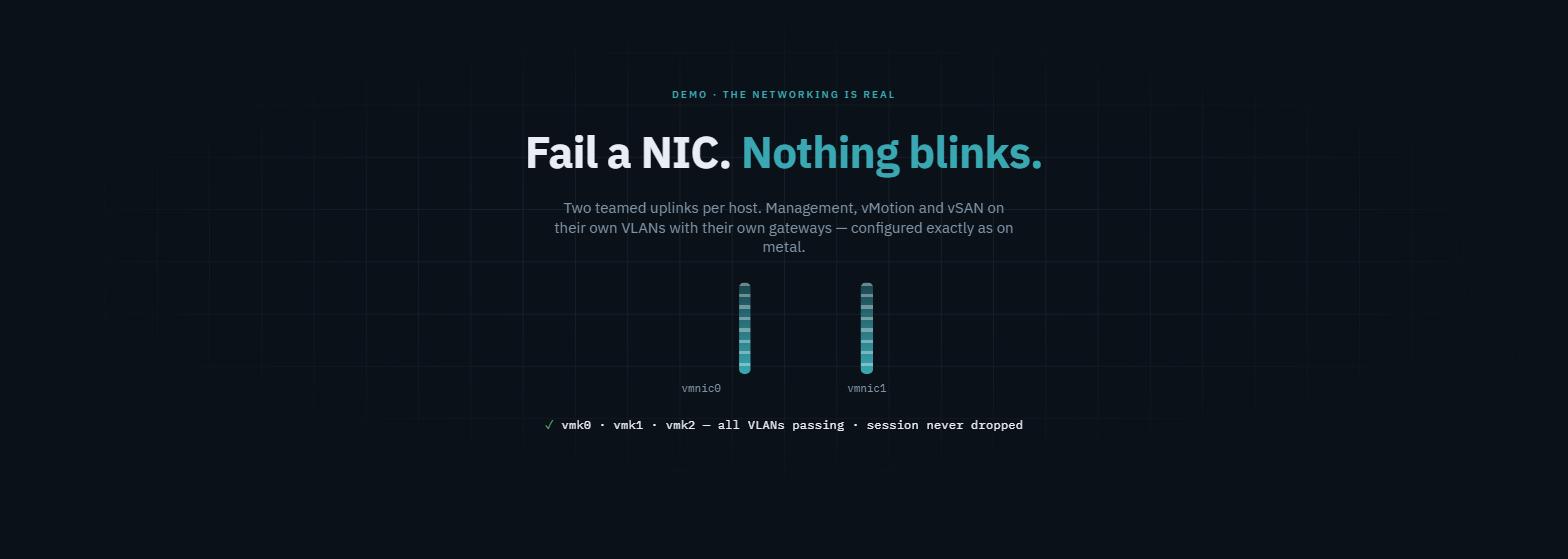
Fail a NIC. Nothing blinks.

Dual-NIC nested hosts: what redundancy means when the fabric is virtual

VCF wants two pNICs per host. In a nested lab the second vNIC adds no physical redundancy — so why add it? Because bringup validation and uplink teaming expect it, and because the failover test tells you something real about the trunk. vmnic0 down, 0% loss, and the SSH session watching it never dropped.

16 September 2026 · 5 min · Adam Stretton