
Every platform needs a demo stack — something that looks alive on a projector and quietly exercises every layer underneath. This is the lab’s: seven apps on a VKS cluster that VCF Automation provisioned, in a tenant VPC, each app behind its own load-balancer VIP.
kubedoom       192.168.144.20:5900   (VNC — yes, it kills pods)
kubeinvaders   192.168.144.21
kube-ops-view  192.168.144.22
pacman         192.168.144.23        (+ MongoDB on a PVC — persistent high scores)
podinfo        192.168.144.24
goldpinger     192.168.144.25        (DaemonSet incl. control plane)
prometheus     (in-cluster: KSM + node-exporter, 11/11 targets up)
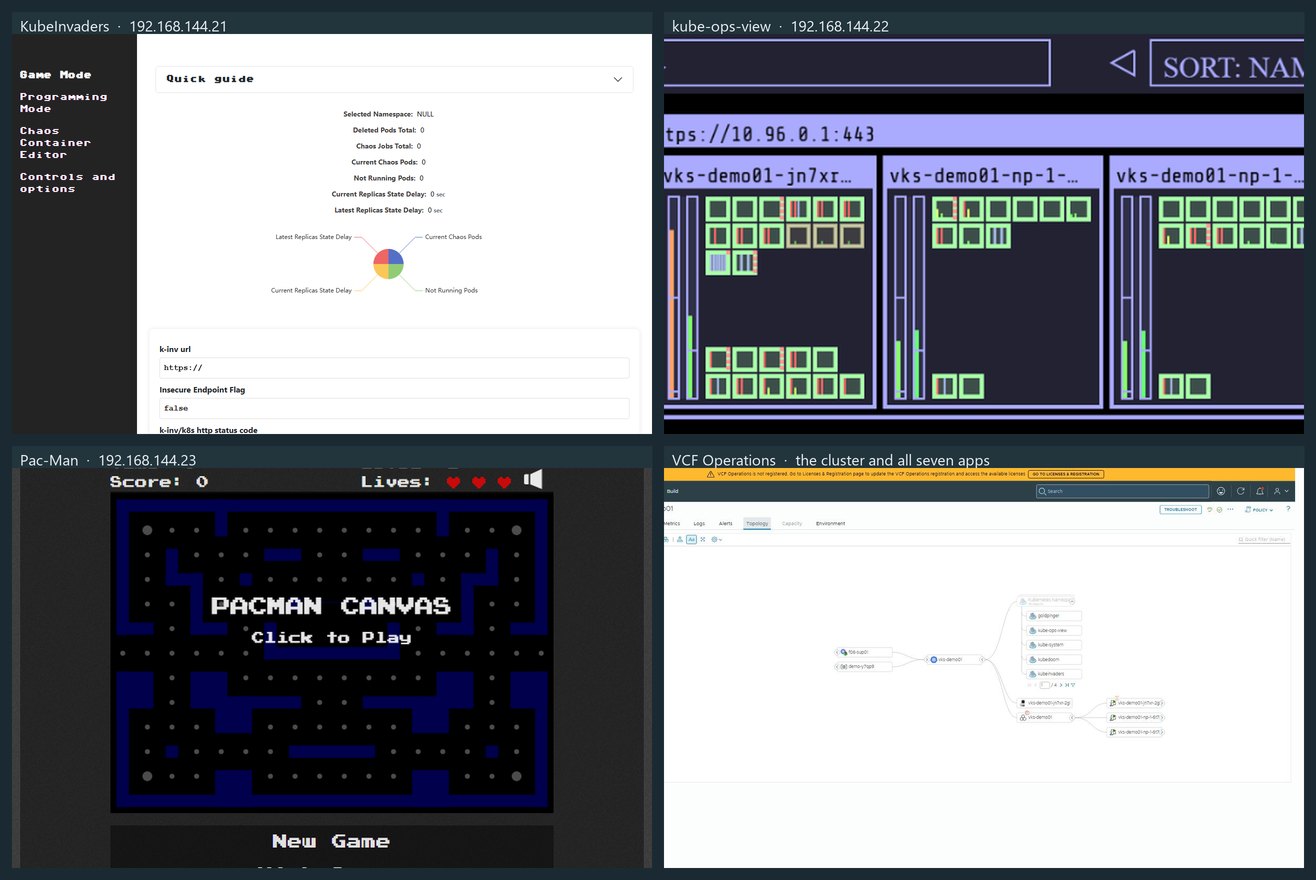 Captured from the VIPs the platform handed out. KubeDoom is VNC-only and podinfo is an API, so they sit this one out; the Ops topology tile shows all seven by name.
The path that matters: tenanted, not shortcut
The first version of this stack was deployed against the supervisor —
an admin kubeconfig, a vSphere namespace, kubectl apply. It worked and
it was wrong, for the reason the previous
post spells out: nothing about it
was provided to anyone. So it was torn down (seven apps, cluster, VPC and
VIPs gone in about seven minutes) and rebuilt the proper way:
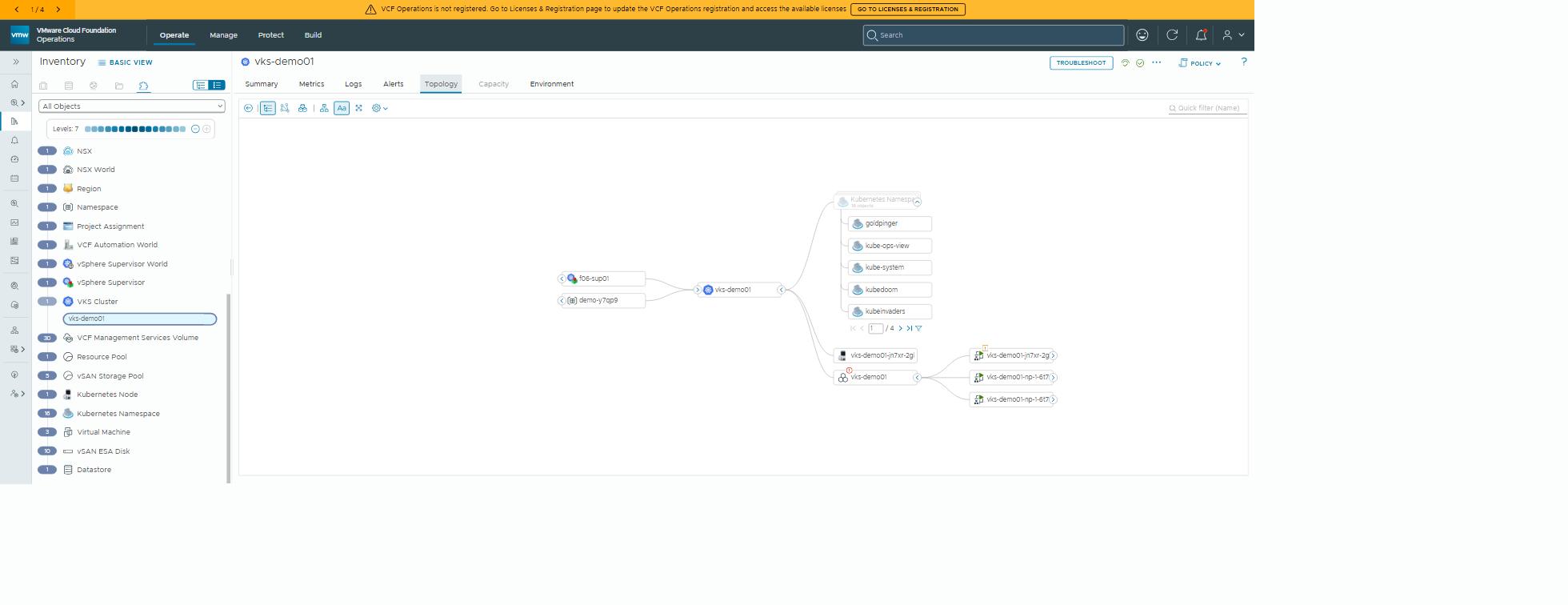
dev-01 org → default-project → SupervisorNamespace (class large, region f06, VPC default-f06)
          → VKS cluster vks-demo01 → seven apps
All created through VCF Automation — the CCI API for the namespace and cluster, then the apps via the cluster’s own kubeconfig. Two auth facts worth writing down, because they cost a cycle each:
- A provider service account reaches the cloud API only. CCI
(
/cci/kubernetes/apis/...) rejects provider tokens with 401 — it needs an org-scoped service account. - Device-flow login uses the service account’s own UUID as
client_id(not its software ID), against the tenant endpoint/oauth/tenant/<org>/device_authorization.
What the platform does for free
Each app is an ordinary Deployment + Service of type LoadBalancer. The
supervisor turns each service into an NSX VPC LB virtual server and hands
back a VIP from the org’s external block. No ingress controller, no
MetalLB, no port-forwarding — seven services, seven VIPs, done. Pac-Man’s
MongoDB asks for a PVC and gets a vSAN-backed volume through the CSI the
supervisor already installed. Goldpinger runs as a DaemonSet across every
node including the control plane and draws the node-to-node mesh live.
That’s three platform services (LB, storage, networking) exercised by apps that know nothing about VCF.
The traps
Supervisor refuses cluster-scoped RBAC — even to admin. Demo apps that need ClusterRoles (kube-ops-view, Goldpinger, KubeDoom) must live on a guest cluster. You cannot run them as vSphere Pods on the supervisor.
PodSecurity restricted is the VKS 1.35 default. Half the demo set
runs as root. Symptom: Deployment shows 0 UP-TO-DATE, ReplicaSet exists,
zero pods, events say FailedCreate. Fix: label the namespace
pod-security.kubernetes.io/enforce=privileged — and mention in the demo
that you did, because it’s a teaching moment.
node-exporter without hostNetwork. The VPC fabric blocks pod → node
IP scrapes, so the stock DaemonSet’s hostNetwork: true doesn’t help;
run it as a normal pod and let Prometheus scrape it in-cluster.
Docker Hub is flaky from behind a proxy. TLS handshake timeouts put pods into kubelet’s image-pull backoff. Deleting the stuck pods bypasses the backoff; a Harbor proxy-cache project fixes it properly.
Pod CIDR shadowing. The stock 192.168.0.0/16 pod range hid the
org’s 192.168.144.0/21 external block from inside the cluster — apps
couldn’t reach their neighbours’ VIPs. Pod CIDR is now 172.16.0.0/16.
Automation notes
The whole stack is a checkbox on the lab’s catalog item that deploys a
supervisor: installDemoApps creates the cluster (newest compatible
Kubernetes release, newest built-in ClusterClass, auto-detected), applies
the seven apps, and reports their URLs in the deployment summary. Run
integrated on a fresh environment: 16.7 minutes to CREATE_SUCCESSFUL.
An immediate re-run: 3.3 minutes, all steps idempotent — which is the
number I actually care about, because it means a broken demo is a re-run,
not a rebuild.
Why this matters outside the lab
A demo stack sounds like a toy. It’s actually the fastest way to make a platform legible to people who don’t read YAML: a customer watches a request become a cluster, watches seven services get their own addresses, opens one and plays it. Everything underneath — self-service Kubernetes, load balancing, persistent storage, isolation — is being exercised in a way a non-technical stakeholder can see working. The same stack is what we put in front of a new team on day one, and the same idempotent deploy is what makes it safe to demonstrate live: if it breaks on stage, it re-runs in three minutes.
Rules learned
- Demo apps that need cluster-scoped RBAC must run on a guest cluster; the supervisor won’t grant it, even to admin.
- Build the stack through the tenanted path (org SA → CCI → namespace → cluster → apps). Same apps, but now they’re provided, quota’d and visible in Ops.
- VKS 1.35:
restrictedPodSecurity by default. Label the namespace and say why. LoadBalancerper app = NSX VIP per app. No ingress needed for a demo.- Pick a pod CIDR that doesn’t overlap the VPC external block.
- Make the deploy idempotent; a demo that re-runs in 3 minutes is one you can afford to break on stage.
Previously: one VKS cluster, two ways. The Pac-Man instance here is the one from What’s a VPC?.
Lab environment; opinions my own.