
The nested hosts exist. Now they need to become a VCF instance: vCenter, NSX, SDDC Manager, the fleet components. The VCF 9.1 Installer appliance does that from a deployment spec — a few hundred lines of JSON — through an API. This post is the vRO workflow that drives it, and the three design constraints that shaped it: nobody edits the spec by hand, the request can’t outlive two hours, and nested hosts fail hardware validation.
Unlike stage 1 this isn’t VM provisioning, so it’s not a cloud template. It’s a vRO workflow published directly as a catalog item through an Orchestrator content source.
The spec is generated, never edited
A vRO action, buildVcfDeploymentSpec(environment, hostFqdns, labPassword, …), returns the whole spec as a string. Its structure was reconciled
against a validated export from a real bringup — the installer UI lets
you export the spec it accepted — and everything variable derives from the
environment number X:
| Element | Pattern | f03 |
|---|---|---|
| Names | f0X-m01-* | f03-m01-vc01.res.lab |
| Subnets | 10.(20+X).<sub>.0/24 | 10.23.1.0/24 (mgmt) |
| VLANs | 2X0<sub> | 2301 mgmt … 2306 TEP |
| Gateways | .254 | 10.23.1.254 |
| vMotion / vSAN ranges | .1–.16 | 10.23.3.1-16 |
| NSX TEP pool | .6.1–.6.32 | 10.23.6.1-32 |
| SDDC Manager | f0X-vcf01.res.lab | f03-vcf01.res.lab |
var n   = parseInt(environment.substring(1), 10);   // "f03" -> 3
var pfx = environment + "-m01";
var net = "10." + (20 + n);
function vlan(o) { return 2000 + (n * 100) + o; }
function gw(sub) { return net + "." + sub + ".254"; }
Static across environments: DNS, NTP, subdomain, component sizes, vSAN ESA FTT=1, and the component build versions pinned to the installer binaries. One lab password feeds every credential field (the UI export scrubs them; the action puts them back per the API schema).
Two spec-level decisions worth stealing:
skipEsxThumbprintValidation: trueinstead of carrying per-hostsslThumbprint. Supported, and the right trade-off for a lab.- Ops and Automation are checkboxes that add their blocks to the spec
— and the installer only accepts a
licenseServerSpecwhen Ops is present, so the action adds them together or not at all.
The workflow: authenticate → validate → start → return
1. POST /v1/tokens                 installer login
2. POST /v1/sddcs/validations      the installer's OWN pre-flight on the spec
   (poll until COMPLETED; fail on any FAILED check)
3. if validateOnly -> return the validation report; touch nothing
4. POST /v1/sddcs                  start bringup -> sddcTaskId
5. return { sddcTaskId, installerUrl }
Step 2 is the validateOnly story made
concrete: the installer will tell you, in seconds, that
f03-m01-nsx01.res.lab doesn’t resolve, that an IP is in use, that a host
isn’t reachable. Two hours into a bringup is a bad time to learn that.
Every one of the ~40 DNS records the pre-flight wants is created ahead of
time by a one-shot PowerShell script (New-LabEnvDnsRecords.ps1) — DNS is
a prerequisite, not a step.
The two-hour leash, and how to slip it
A request from the catalog carries a token with a roughly two-hour
lifetime, and a bringup takes around eight. So by default the workflow
is fire-and-forget: waitForCompletion=false, return the task id, watch
progress in the installer UI. A watchTaskId input lets you re-attach
later and poll an already-running bringup from a new request.
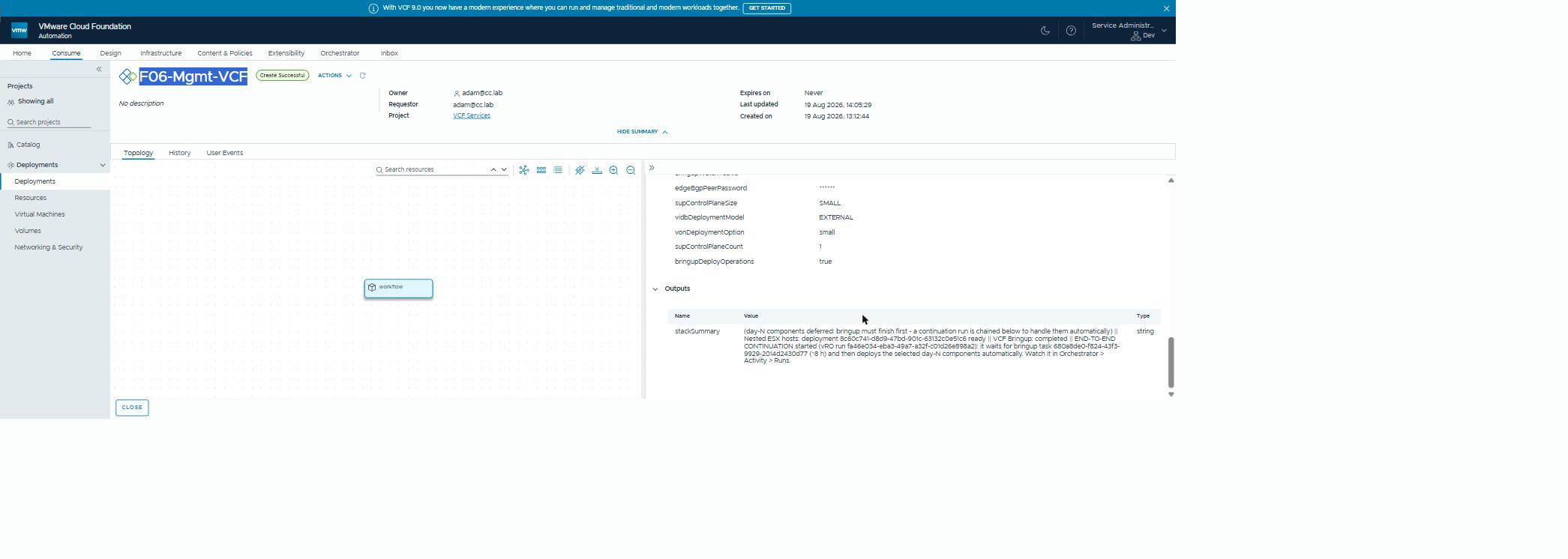
The wrapper that chains everything — hosts, bringup, then the day-N
components that need bringup to be finished — has a neater trick. The
catalog-bound parent deploys the hosts, submits bringup, and then
re-executes itself as a plain vRO run (Orchestrator → Run, no catalog
token, no two-hour kill) carrying the hidden bringupWatchTaskId. That
continuation polls the installer task to completion — eight hours, fine —
and then runs certificates, fleet items, edge, supervisor and identity.
Watch it under Orchestrator → Activity → Runs. The catalog request
itself completes in under an hour — 47 minutes on the run pictured below — having
started the work correctly and handed off.
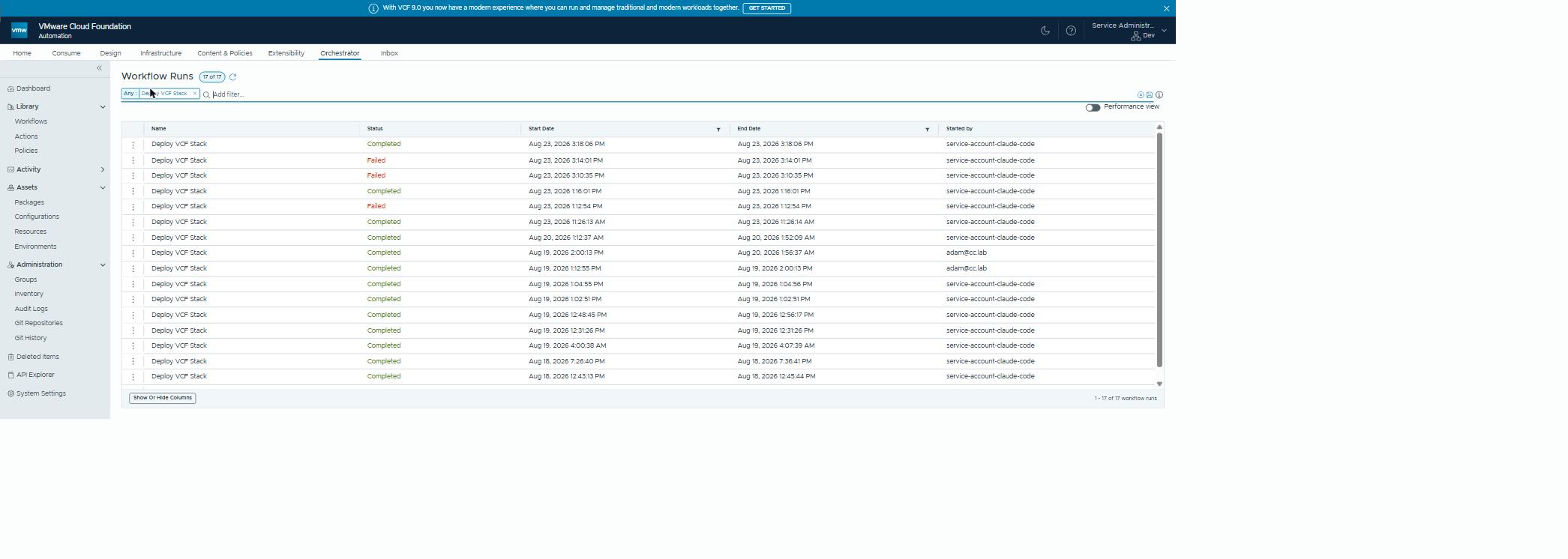 Two rows, one build. The parent returns inside the catalog’s window; the continuation waits out the bringup and does the day-N work.
Nested-host frictions
Three things a physical bringup never meets:
- HCL validation vs virtual NVMe. The installer’s hardware check
blocks the virtual NVMe controller. Fix at the vLCM layer:
enforce_hcl_validation=falseon the image policy. The vSAN health testnvmeonhclalso complains; silenced via the vSAN API, best-effort with manual fallback. - DVS compatibility appears late. After bringup, NSX takes 1–2 hours to settle before the supervisor’s zones endpoint stops returning 500. If the supervisor stage fails “No compatible DVS” on a fresh instance, wait and re-run just that item.
- TSM-SSH. Bringup wants SSH on the hosts; the wrapper enables it host-direct via SOAP before submitting.
Stale schema: the failure that looks like a bug and isn’t
Add an input to the vRO workflow after the catalog item exists and the form will show the new field, the request will record its value, and the workflow will receive null — Service Broker keeps the old request schema until the content source re-imports. The workflow null-guards every boolean and aborts with “inputs not mapped” rather than running with silently-wrong options. Fix: re-import the content source, confirm the schema, submit a new request (resubmitting an old one reuses the old payload).
There are actually three async layers between “publish” and “mappable request” — vRO processing the import, the catalog schema after re-import, and the form service still enforcing the previous custom form for a minute or two. Same symptom for all three. Check timing before assuming a bug.
Why this matters outside the lab
Repeatable, generated VCF deployments matter well beyond a lab: a second site, a disaster-recovery instance, a new business unit, an environment per supported release. Generating the specification from a validated reference removes the class of errors that comes from editing hundreds of lines of JSON by hand, and running the installer’s own validation first turns “find out in hour two” into “find out in minute one”. It’s the difference between a VCF deployment being a project and being a procedure.
Rules learned
- Generate the spec from a validated export plus one number. Nobody hand-edits JSON at 2am.
- Run the installer’s own validation first, and make it a mode you can request on its own.
- Pre-create DNS. Enable SSH. Disable HCL enforcement on virtual NVMe.
- Respect the request lifetime: start, return a task id, re-attach. For a long chain, have the workflow re-run itself outside the catalog.
- Null-guard every input and fail loud; stale schemas are a fact of life after adding inputs.
- On a fresh instance, give NSX an hour before you expect DVS compatibility.
Part of The Lab Factory. Previously: porting the host script.
Lab environment; opinions my own. Bringup verified end-to-end on a
rebuilt environment: 305/305 tasks, COMPLETED_WITH_SUCCESS.