“Naturally, a VCF host has at least two NICs. Are we testing that, or have you virtualised it away?”
Fair question, and the honest answer has two halves. In a nested lab the physical redundancy is provided by the outer host — its vDS, its NSX uplinks — and a second vNIC on the nested VM adds precisely none. But VCF doesn’t know it’s nested. Bringup’s host validation and the vDS uplink teaming it configures expect two vmnics, and a host with one gets flagged. So the nested hosts get two vNICs, both on the trunk subnet, and the question becomes: does failover between them actually work inside a VPC?
The setup
Both vNICs attach to the same sn-trunk subnet — the trunk from part
1 — and ESXi sees them as two 10G vmnics:
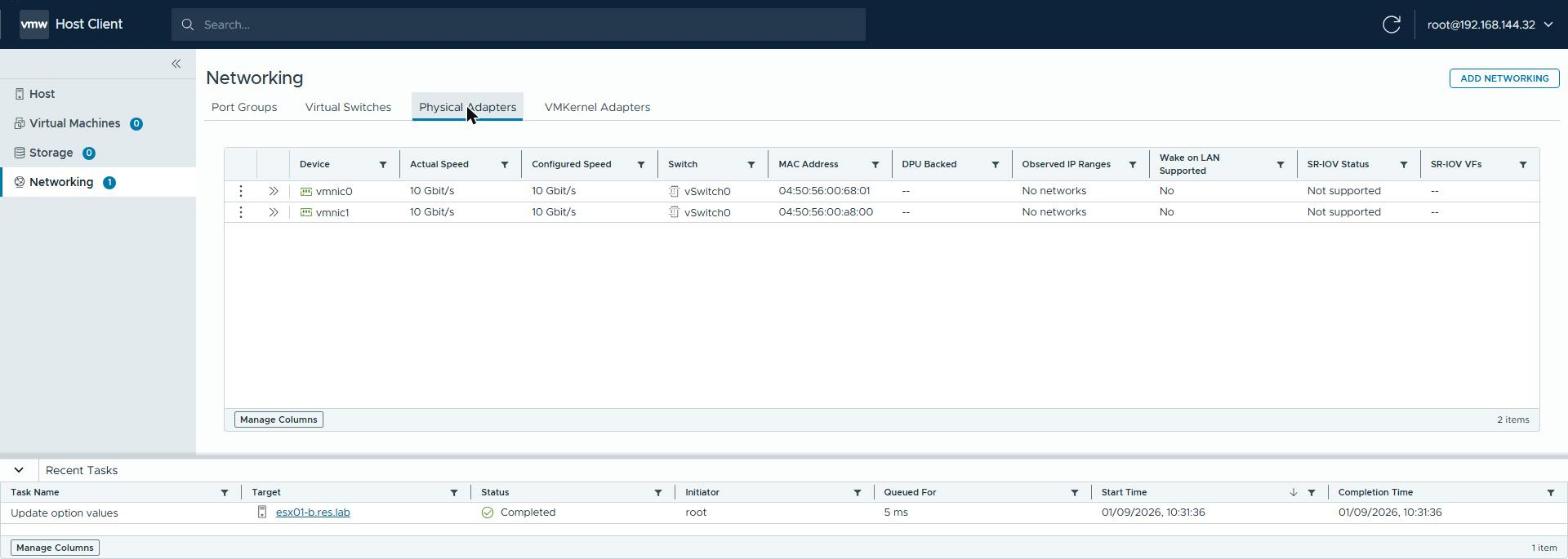
vSwitch0 teams them active/active with the default originating-port-ID policy; every portgroup (Management 1610, vMotion 1611, vSAN 1612) inherits it. Nothing you wouldn’t do on metal.
The test: pull a NIC while watching from inside
The interesting bit isn’t whether pings continue — it’s which session
I’m watching from. I’m SSH’d to esx01 through its public VIP, which
means my session traverses the NSX LB → the VPC → the trunk port → whichever
vmnic happens to carry vmk0. If failover breaks anything, it breaks the
terminal I’m typing in.
[root@esx01-a:~] esxcli network nic list
Name    ...  Admin Status  Link Status  Speed  MAC Address
vmnic0  ...  Up            Up           10000  04:50:56:00:5c:03
vmnic1  ...  Up            Up           10000  04:50:56:00:68:00

[root@esx01-a:~] esxcli network nic down -n vmnic0    # FAIL THE FIRST NIC
vmnic0  ...  Down          Down             0  04:50:56:00:5c:03
vmnic1  ...  Up            Up           10000  04:50:56:00:68:00

[root@esx01-a:~] vmkping -I vmk1 172.30.0.71          # vMotion VLAN, now over vmnic1
3 packets transmitted, 3 packets received, 0% packet loss

[root@esx01-a:~] vmkping -I vmk2 172.30.0.101         # vSAN VLAN, now over vmnic1
3 packets transmitted, 3 packets received, 0% packet loss

[root@esx01-a:~] esxcli network nic up -n vmnic0      # restore
# session never dropped.
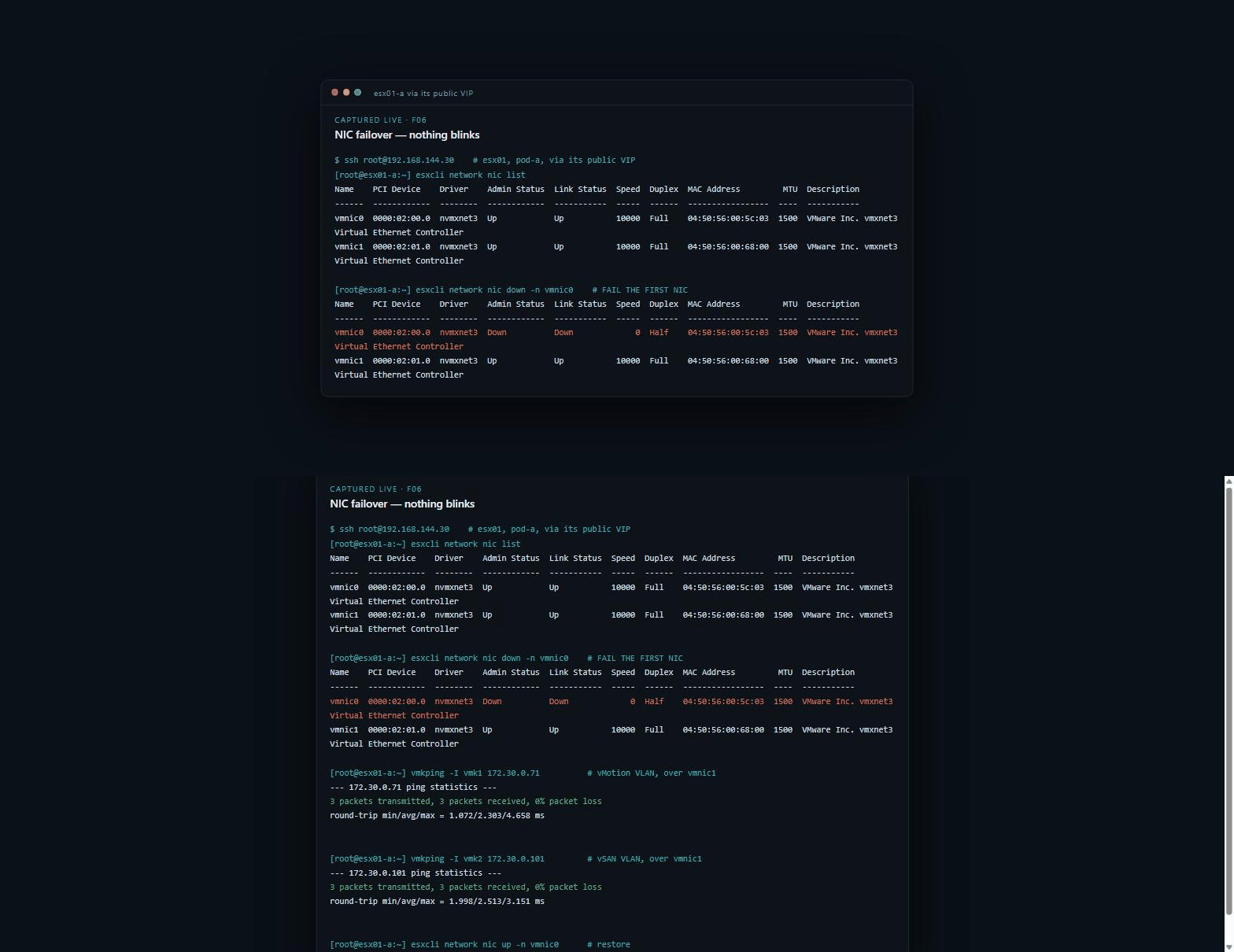
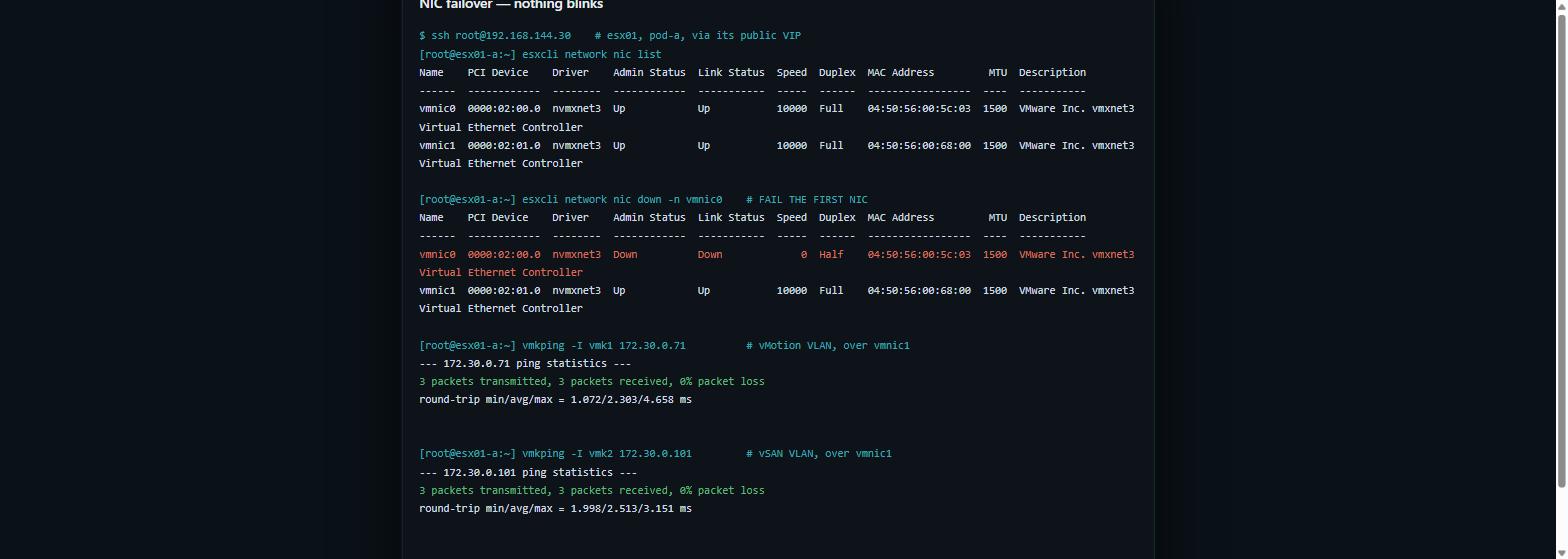
Every VLAN moved to vmnic1. Zero loss on vMotion and vSAN. And the management session — the one most likely to notice — never blinked.
Why this is a real result, not a party trick
Think about what just happened at the NSX layer. vmk0’s MAC — a MAC ESXi synthesised, not the vNIC’s — was being learned on trunk port A. When vmnic0 went down, the same MAC appeared on trunk port B mid-flow, with an established TCP session riding on it.
On a standard VPC subnet port that is exactly the scenario SpoofGuard exists to stop: the port’s address bindings pin one MAC, and a frame from a different MAC — or the same MAC arriving on a different port — is dropped. Part 1 showed that killing the host on a standard subnet before it ever spoke. This test shows the trunk subnet tolerating the live migration of a foreign MAC between two of its ports, which is the property nested vSphere (and anything else with a vSwitch inside a VM) fundamentally needs.
So the second vNIC buys three things, none of them physical redundancy:
- Bringup and vLCM stop complaining about a single-uplink host.
- The teaming policy you’ll configure in production gets exercised — uplink failover, active/standby for vSAN, whatever you’re rehearsing.
- A live proof that the trunk carries MAC mobility, which is the real assurance that the design isn’t relying on a quiet network.
What it does not buy, and how to say so
If someone asks “is this host redundant?”, the answer is “the nested host believes it is; actual redundancy lives one layer down.” In a training pod that’s the correct and useful answer — students configure and test failover exactly as they would on metal, and the outer platform does the real work. In a reproduction lab for a customer NIC-teaming issue, it’s usually enough too: most teaming bugs are in ESXi’s policy handling, not in the copper.
Where it’s genuinely insufficient: anything about physical link behaviour — LACP negotiation, LLDP, flapping, MTU mismatch on one uplink. The virtual fabric never fails asymmetrically, so it can’t reproduce those.
Why this matters outside the lab
The practical value here is knowing what a nested environment can and can’t prove — which is what lets you decide when a virtual lab is enough and when it isn’t. For training, upgrade rehearsals, configuration and policy testing and the vast majority of “how does it behave when…” questions, nested is enough and dramatically cheaper. For physical link behaviour — LACP, optics, asymmetric faults — you still want metal. Being able to make that call confidently is worth more than the test itself.
Rules learned
- Give nested VCF hosts two vNICs on the same trunk subnet. Bringup, vLCM and vDS teaming expect ≥ 2 vmnics; humouring them costs nothing.
- Test failover from a session that depends on it (SSH via the VIP). Pings passing while your terminal dies is not success.
- The trunk subnet tolerates a vmk MAC moving between ports mid-flow — that’s the property standard subnets lack and nested vSphere needs.
- Be precise in the write-up: nested dual-NIC gives policy realism, not physical redundancy. Physical link faults can’t be reproduced here.
- Rebuilds re-run the vmk config: the appliance creates vmk0 only; vmk1/vmk2, their VLANs and override gateways are applied post-boot.
Companion to nested ESXi inside an NSX VPC.
Lab environment; opinions my own. Output captured live, trimmed for length, never edited for outcome.