
Logs from a Kubernetes cluster and logs from a Windows server end up in the same place — VCF Operations for Logs — but the paths there couldn’t look more different. On VKS, fluent-bit is a package: declare a values secret, reconcile, done. On Windows it’s a service: install, write a config by hand, restart, tail the debug log. Same binary, same output plugin, same endpoint. This post is both, side by side, so the shared shape is obvious.
The endpoint
VCF Operations for Logs ingests over its CFAPI on port 9543:
https://<ops-logs>:9543/api/v2/events
Auth is Ops-side (the ingestion endpoint accepts from configured sources);
what matters for fluent-bit is the URI, the port, TLS, and a JSON body
shaped as {"events":[...]}. Both shippers below produce exactly that.
Way 1: VKS package
VKS ships fluent-bit in its standard package repository. On a cluster with the repo registered:
kubectl get packages -A | grep fluent-bit
  fluent-bit.fluent-bit.tanzu.vmware.com   4.0.5+vmware.1-vks.1
A values secret configures the output — the package’s own default output shape targets CFAPI, so the values are short:
fluent_bit:
  config:
    outputs: |
      [OUTPUT]
        Name    http
        Match   *
        Host    f06-flt-log01.res.lab
        Port    9543
        URI     /api/v2/events
        Format  json
        tls     On
        tls.verify Off
        json_date_key    timestamp
        json_date_format iso8601
Then a PackageInstall referencing it:
apiVersion: packaging.carvel.dev/v1alpha1
kind: PackageInstall
metadata: {name: fluent-bit, namespace: tanzu-packages}
spec:
  serviceAccountName: tanzu-packages-sa
  packageRef: {refName: fluent-bit.fluent-bit.tanzu.vmware.com, versionSelection: {constraints: 4.0.5+vmware.1-vks.1}}
  values: [{secretRef: {name: fluent-bit-values}}]
Reconcile succeeded, and the proof is in the pod logs, not the Ops UI —
Ops for Logs’ API auth is identity-broker federated, so scripted
verification from the shipper side is far easier:
[ info] [output:http:http.0] f06-flt-log01.res.lab:9543, HTTP status=200
[ info] [output:http:http.0] f06-flt-log01.res.lab:9543, HTTP status=200
One 200 per batch. That’s the whole VKS side, and it’s why the packaged path is the one to recommend: the inputs (container logs, kubelet, systemd) are pre-wired, the parsers are right, and the only decision you make is the output.
One trap (shared with Telegraf, next post):
a cluster created without clusterNetwork.serviceDomain produces in-cluster
service names of the form ...svc. with no domain, which some add-ons
build into unresolvable URLs. It’s immutable after create; set it
explicitly on every new cluster.
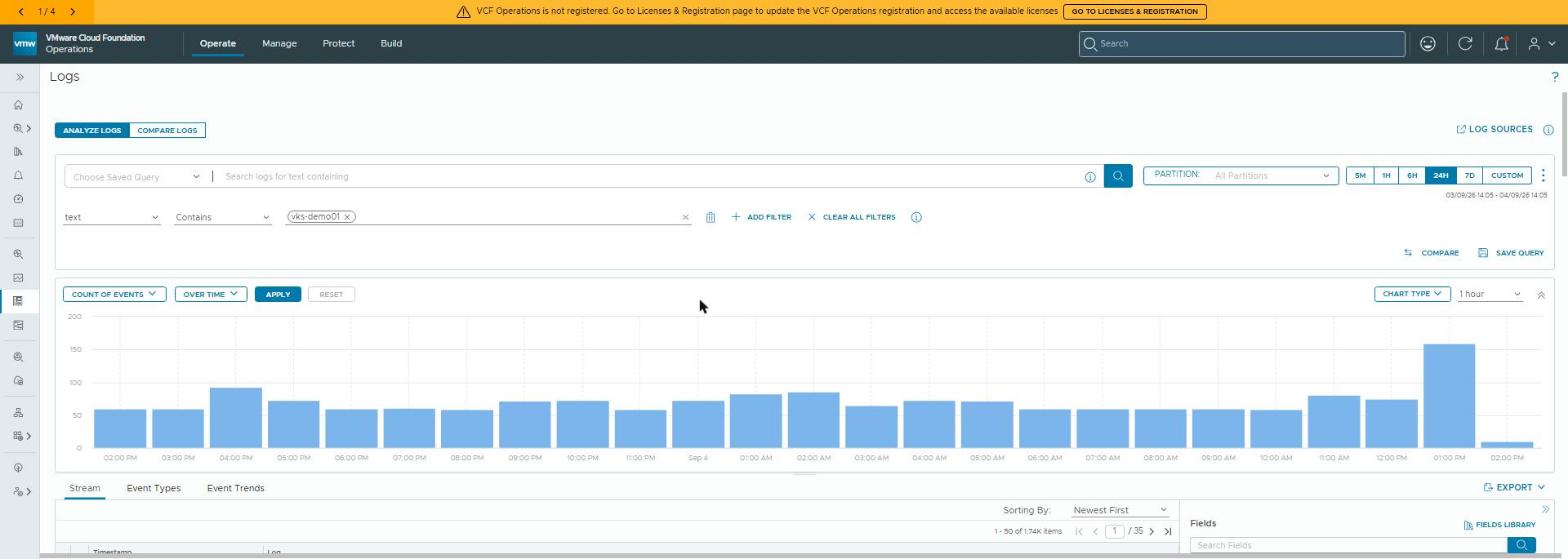 The receiving end. One filter —
 text contains vks-demo01 — and a day of the cluster’s logs, one bar per hour.
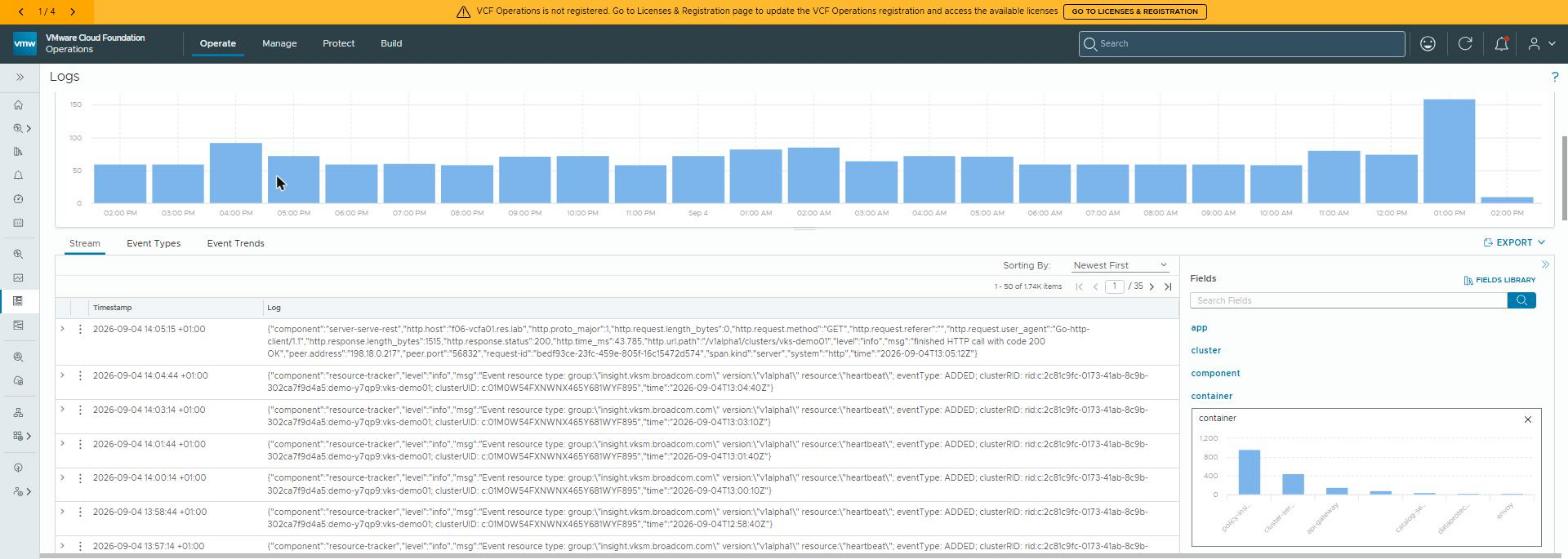 Every event carries the fields the package’s filters add —
 cluster, kubernetes_namespace, pod, container — which is what makes the Windows-vs-VKS comparison in one explorer possible later.
Way 2: Windows Server 2025 service
fluent-bit ships a Windows build with a winevtlog input. On the
pipeline-built W2025 server I used the
portable zip rather than the MSI — no installer, a folder under C:\, a
service registered with sc.exe. The config is short and every line of it
turned out to matter:
[INPUT]
    Name          winevtlog
    Channels      System,Application,Security
    DB            C:\fluent-bit\winevt.db        # bookmark: no replay after restart
    String_Inserts On

[FILTER]
    Name    modify
    Match   *
    Rename  Message  text                     # <- the field Ops actually indexes
    Add     hostname TEST-W2025
    Add     appname  v-windows

[OUTPUT]
    Name    http
    Host    f06-flt-log01.res.lab             # FQDN, never the IP
    Port    9543
    URI     /api/v2/events
    Format  json
    json_date_key    timestamp
    json_date_format epoch_ms                 # milliseconds, not ISO, not seconds
    tls     On
    net.dns.resolver LEGACY                   # Windows: c-ares can't resolve
The service came up first time. Getting a single event to land took four attempts, and each failure taught something the documentation doesn’t say:
[error] [output:http:http.0] no upstream connections available to f06-flt-log01.res.lab:9543
1. fluent-bit couldn’t resolve a name Windows could. Resolve-DnsName
worked; Test-NetConnection … -Port 9543 worked; fluent-bit’s own async
resolver didn’t. net.dns.resolver LEGACY hands DNS back to the OS.
[error] [output:http:http.0] 10.26.5.25:9543, HTTP status=404
2. The appliance routes on the Host header. Sidestepping DNS by using the IP gets a 404 for every path. Address it by FQDN.
{"errorMessage":"Cannot deserialize value of type `java.lang.Long` from String \"2026-09-16T10:55:00.000000Z\""}
3. Timestamps must be numeric. fluent-bit’s iso8601 output is a
string; the ingest API wants a Long. Worse: it reads that number as
milliseconds, so the default double (epoch seconds) is accepted with
a 200 and files your events in January 1970. epoch_ms.
{"received":0,"message":"events ingested","status":"ok"}
4. The message field must be called text. Anything else — Message
as winevtlog emits it, message, log — returns 200 and
received: 0. Silently dropped. Hence the Rename filter. Broadcom’s own
reference config for Windows carries exactly this line; I found it the hard
way first.
Then, finally:
[ info] [output:http:http.0] f06-flt-log01.res.lab:9543, HTTP status=200
[ info] [output:http:http.0] f06-flt-log01.res.lab:9543, HTTP status=200
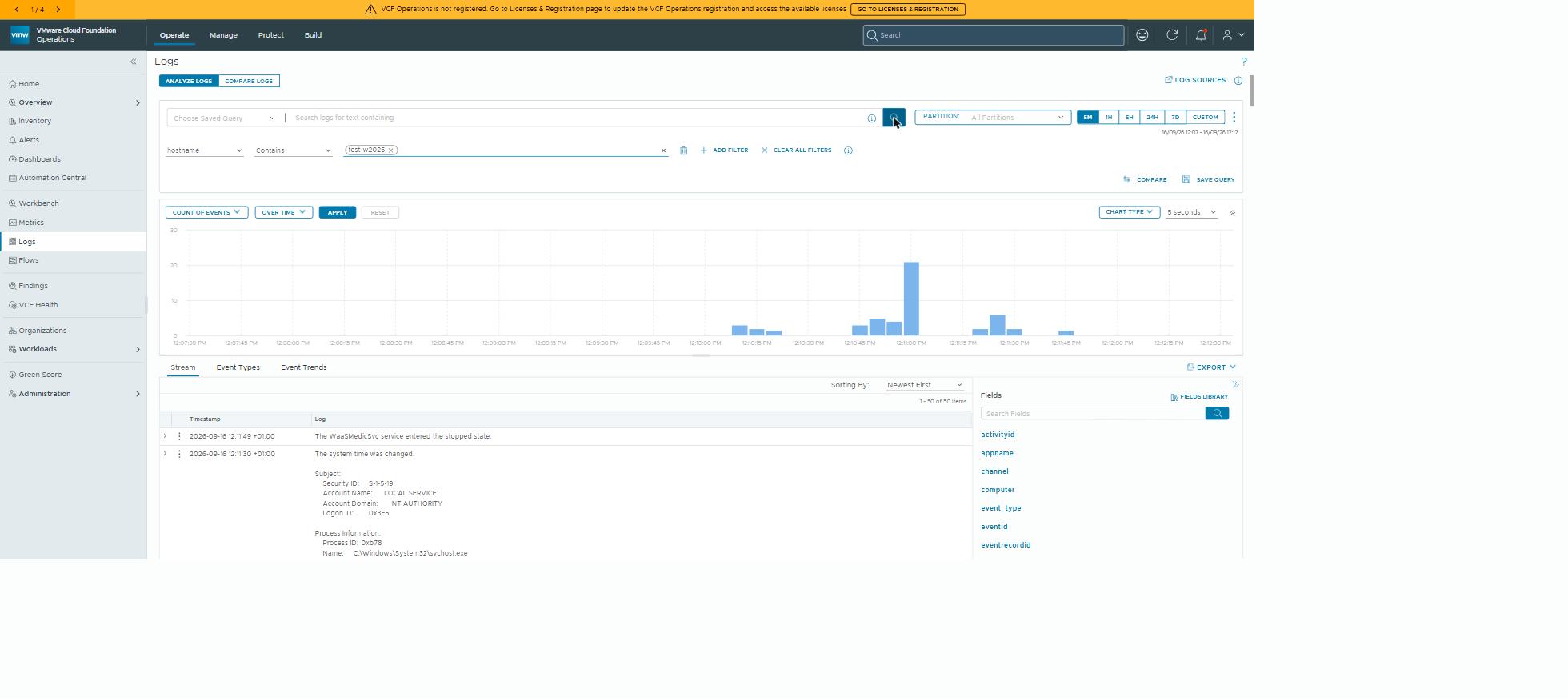 Fifty events in the first five minutes: service state changes, a “system time was changed” security event with its full subject block, all searchable with the same fields as everything else.
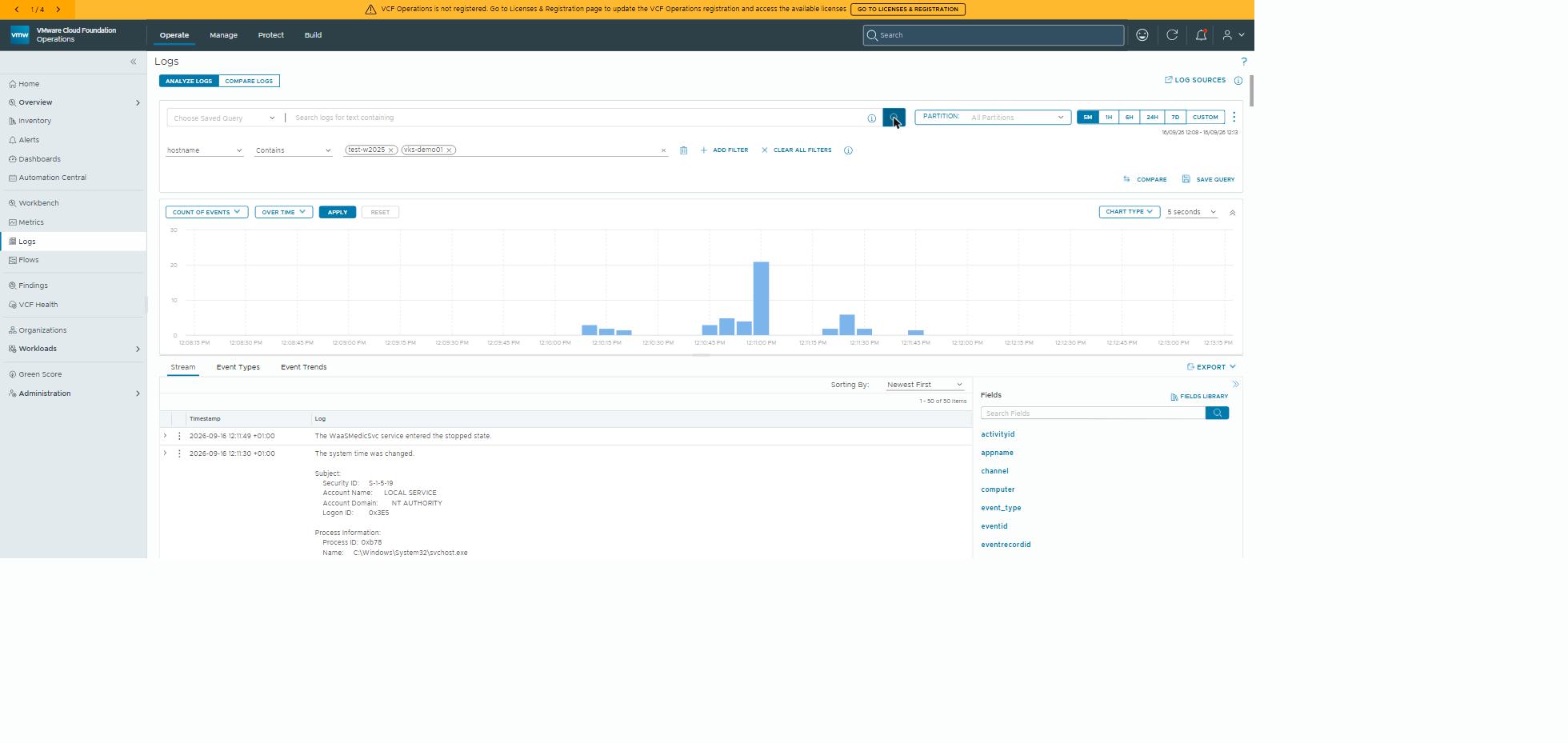 One filter, two worlds. A Windows server and a Kubernetes cluster, in the same query, in the same store.
One more Windows-specific note: a bare fluent-bit.exe registered with
sc.exe isn’t a proper service binary — it ignores the stop signal and
Windows sits at “waiting for service to stop” until you kill the process.
The MSI installs a real service wrapper; use it for anything that isn’t a
lab.
The shape they share
| VKS package | Windows service | |
|---|---|---|
| Install | PackageInstall | MSI / sc.exe create |
| Config | values Secret | fluent-bit.conf |
| Inputs | pre-wired (containers, kubelet, systemd) | winevtlog channels you choose |
| Output | http → CFAPI :9543 /api/v2/events | identical |
| Verify | pod log HTTP status=200 | service log HTTP status=200 — and check the date on what arrived |
| Restart safety | Kubernetes | DB bookmark file |
The output stanza is byte-identical. That’s the lesson: standardise the sink and let each platform own its source.
Why this matters outside the lab
The business outcome is one place to look. Windows servers, Kubernetes clusters and the platform itself all ship logs to the same VCF Operations for Logs, with the same fields, searchable in one query — so an incident that spans a Windows service and a container gets investigated in one screen instead of three tools. Standardising the destination while letting each platform keep its native shipper is also what keeps the estate maintainable: one endpoint to secure and retain, no bespoke agent per team.
Rules learned
- Ops for Logs ingestion = CFAPI
:9543/api/v2/events, JSON. One output stanza serves every shipper. - On VKS, use the package; decide only the output. Verify from the pod log — the Ops API is awkward to script against.
- Set
serviceDomainon every new VKS cluster; it’s immutable. - On Windows: FQDN not IP (Host-header routing),
net.dns.resolver LEGACY,Rename Message text,json_date_format epoch_ms. Each one fails differently and two of them fail silently. - A
200is not proof.received: 0is a drop; a seconds timestamp is a 200 filed in 1970. Look for the event in the explorer before you call it done. - Prove “one endpoint” with one explorer view showing both sources.
Next: Telegraf on Windows Server 2025 — unsupported, works anyway.
Lab environment; opinions my own.