Every lab has one: the script that builds the nested hosts. Ours was
esxihostdeploy.ps1 — ovftool plus PowerCLI, an interactive menu for
environment, ESX version, role, size, host count, then a loop of
ovftool --prop:guestinfo.*, Set-VM, New-NetworkAdapter, Set-HardDisk.
It worked for years. It also prompted for credentials, lived on one
machine, and knew nothing about the bringup that came after.
Porting it to a VCF Automation catalog item (VM Apps — a cloud template plus vRO) is not a rewrite. It’s a sorting exercise: every behaviour in the script has a natural home in the declarative model, and the skill is finding it. Here’s the whole table, then the four rows that took thought.
The mapping
| Script behaviour | Where it lives now |
|---|---|
| Environment menu (f01–f10) | environment input (enum) |
| Version menu → OVA path on a share | esxVersion input → image mapping → content library item |
| Role menu (management / workload / both) | role input; “both” = two requests |
| Size menu / auto-detect from an existing host | size input (auto-detect dropped — see below) |
| vCenter + ESXi credential prompts | vCenter creds gone (cloud account); esxiRootPassword an encrypted input |
Next-free esxNN index scan (gap-filling) | vRO action getNextEsxHostIndexes, bound to the request form |
| VLAN / IP / gateway arithmetic | template expressions (same formulas) |
ovftool --prop:guestinfo.* | ovfProperties on Cloud.vSphere.Machine |
Folder lookup / New-Folder | allocation-phase subscription creates the folder if missing |
Set-VM cpu / mem | cpuCount / totalMemoryMB in the template |
2× New-NetworkAdapter (Vmxnet3) | networks array, deviceIndex 0/1/2 |
3× Set-HardDisk grow | post-provision subscription |
NestedHVEnabled = $true | post-provision subscription |
| “Power on after?” prompt | powerOn input, honoured post-provision |
| Summary table printed at the end | the deployment view in the UI |
Five homes, in decreasing order of preference: input, template expression, platform abstraction (image mapping, network profile, cloud account), form action (read-only lookup at request time), subscription (imperative work at a lifecycle stage). Push each behaviour as far up that list as it will go.
The four decisions that weren’t obvious
1. Drop auto-detect; the platform already remembers
The script inspected an existing host to infer size. That was a workaround for having no record. The catalog is the record — deployment history shows what size every existing host was requested at — so the input simply asks. Fewer moving parts, and the requester sees the choice.
2. The index scan is a form action, not a workflow step
“Next free esx07” has to be known at request time so the requester
sees the names they’ll get. That’s a vRO action bound to the custom
form (getNextEsxHostIndexes(environment, role, count) → array of
strings), not a step inside provisioning. Forms can call actions; use it
for anything that’s a lookup.
3. Rename and folder go in Compute Allocation, hardware goes in Post Provision
Two blocking subscriptions, filtered by a custom property on the template:
| Subscription 1 | Subscription 2 | |
|---|---|---|
| Topic | Compute allocation | Compute post provision |
| Runnable | “Set VM Name & Folder” | “Finalize Hardware” |
| Does | sets resourceNames, creates folder | grows 3 disks, NestedHVEnabled, power on |
| Timeout | 10 min | 30 min |
The rename must be at allocation — it’s the only stage where a workflow
output named resourceNames is applied to the machine. Disk growth and
nested-HV need a VM that exists, so they wait for post-provision. Both
are blocking: the deployment doesn’t proceed until they return.
4. nestedEsx: 'yes' — not true
The subscription condition is
event.data.customProperties.nestedEsx == "yes". Why not "true"?
Because boolean-looking strings can arrive in the event payload as typed
booleans, and true == "true" is false in the condition evaluator and
in the vRO code. It fails silently — the subscription just never fires.
yes can’t be coerced. Small thing; two hours.
What stayed exactly the same
The formulas. 10.(20+X).<sub>.0/24, VLAN 2X0n, gateway .254 — they
were string concatenation in PowerShell and they’re template expressions
now, character for character. The guestinfo.* property names — identical,
because the OVA didn’t change. Porting a script well means most of it
survives; only the plumbing moves.
The bits that still bite
- Network profile without IP ranges. Addressing is injected via
guestinfo, not the platform’s IPAM. Tag the trunk portgroup, add no ranges, or IPAM and guestinfo will disagree. - Two template revisions in the repo. v1 is what the guide documents; v2 grew later. Both kept deliberately, both labelled. Check which one the org has imported before editing either.
- Content-source lag. A new or changed vRO action needs ~15–20 minutes of data collection before the form sees it. Publish, wait, then test.
- Small disks and OSDATA. Nested hosts with 64 GB disks ship ESX-OSDATA at essentially the whole disk. Templates now provision 128 GB; a relocate-scratch script mitigates existing hosts.
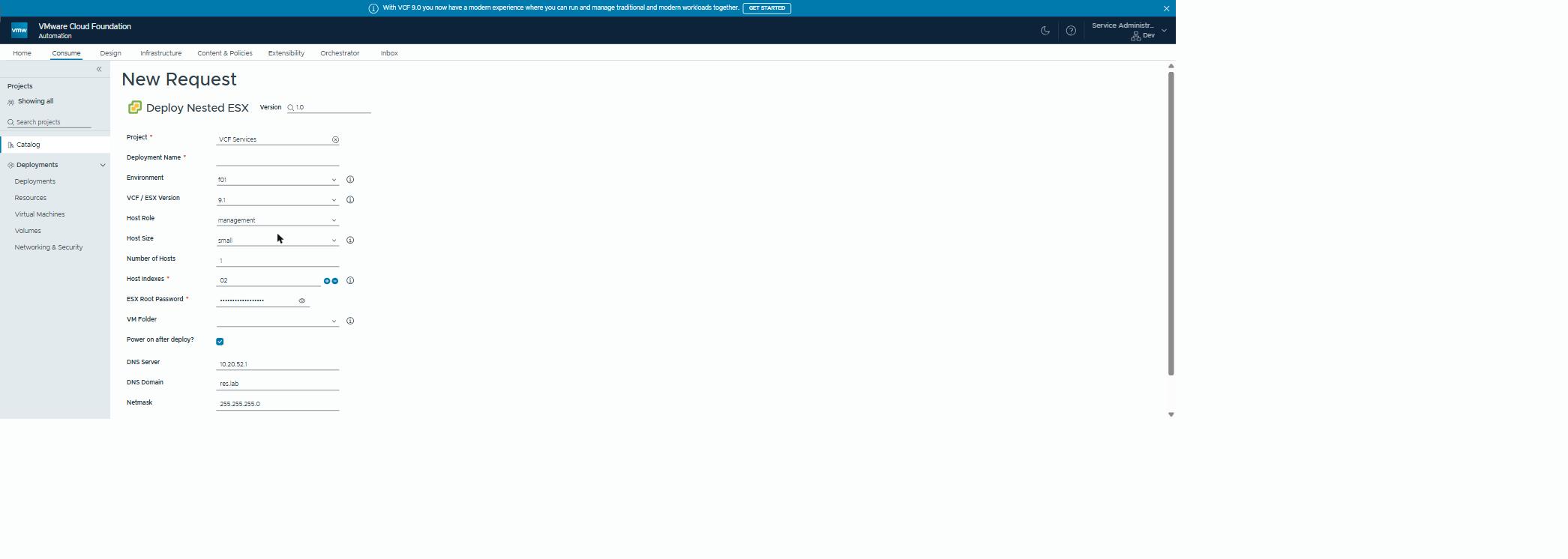 Every menu prompt from the script is now a field;
 Host Indexes is the form action’s answer to “next free esxNN”.
Why this matters outside the lab
Almost every organisation has these scripts: valuable, trusted, and stuck on one person’s machine. The message of this post for them is that modernising doesn’t mean rewriting. The logic survives; what changes is where it lives — behind a request form with access control, an audit trail, consistent inputs and a deployment record. That’s how a team turns tribal knowledge into a service without losing the years of edge cases the script already handles.
Rules learned
- Porting is sorting: input → expression → platform abstraction → form action → subscription. Push each behaviour as far up as it goes.
- Lookups the requester needs to see are form actions.
- Rename at allocation (
resourceNamesoutput); hardware at post-provision. Both blocking. - Filter subscriptions on a custom property, and make its value a word that can’t be coerced to a boolean.
- Drop workarounds for missing state; the catalog is the state.
- Keep the formulas. Move the plumbing.
Part of The Lab Factory. Next: driving the VCF Installer API from vRO.
Lab environment; opinions my own.