
The pods from the last post are perfectly isolated. That’s the requirement — and immediately the problem. Every one of them needs Windows updates, a package repo, DNS, maybe a domain controller. Do I really run a WSUS per pod?
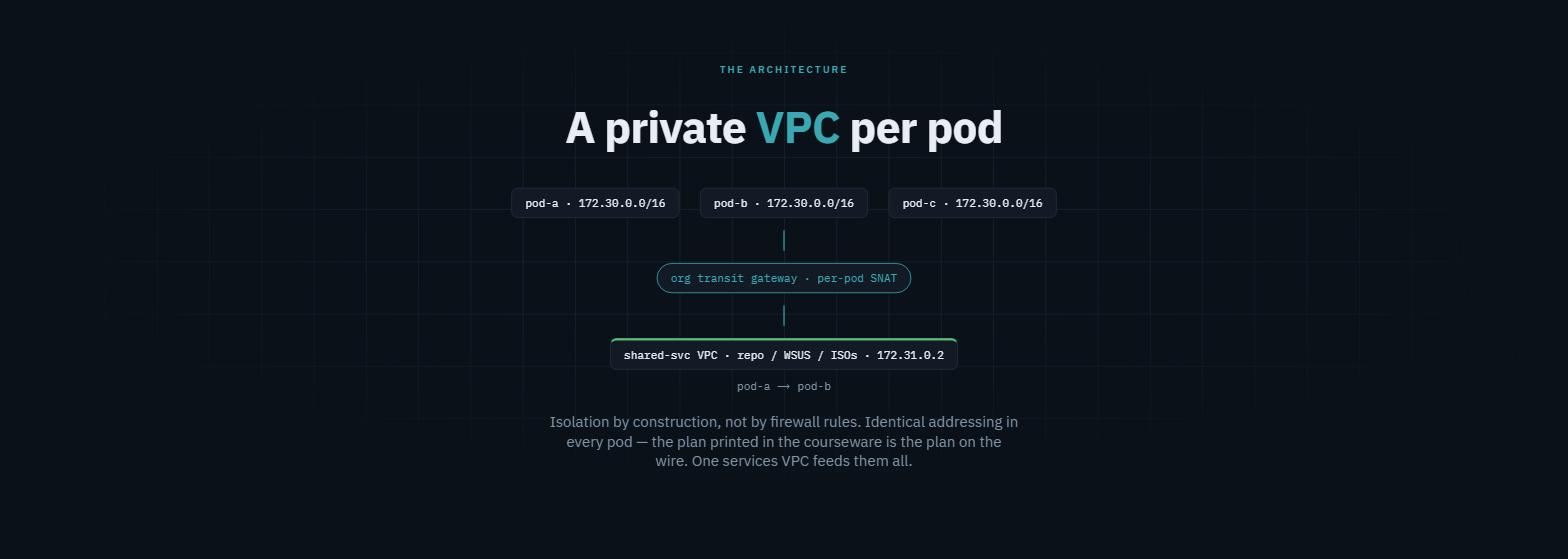
No. There’s a third subnet access mode for exactly this, and the design it enables is hub-and-spoke with a very specific property: spokes reach the hub; the hub cannot reach the spokes; spokes never reach each other.
The three access modes
Everything in this series comes down to one field on a VPC subnet:
accessMode | Advertised to | Use |
|---|---|---|
Private | nobody outside the VPC | workloads — isolation and overlapping CIDRs |
PrivateTGW | every VPC attached to the org’s transit gateway | shared services |
Public | the external network | internet/corp-facing endpoints |
PrivateTGW subnets draw their addresses from a separate transit
block (here 172.31.0.0/…), not from the VPC’s own privateIPs. That’s
the key: the shared range can’t collide with the pods’ 172.30.0.0/16
because it comes from a different pool that all VPCs agree on.
The build
One more VPC, shared-svc, with the same ordering rules as any other
(VPC → VPCAttachment → LoadBalancer → namespace), then a single subnet:
apiVersion: crd.nsx.vmware.com/v1alpha1
kind: Subnet
metadata: {name: sn-services}
spec: {accessMode: PrivateTGW, ipv4SubnetSize: 32}
It realized as 172.31.0.0/27, and a VM on it — svc-repo01,
172.31.0.2, serving HTTP — became the shared repo.
The test that matters is directional
Reachability to the service is the easy claim. From esx01 in each of
the three pods (ESXi ships python3, so urllib is the test client):
pod-a esx01 -> http://172.31.0.2/   200  shared-svc repo01
pod-b esx01 -> http://172.31.0.2/   200  shared-svc repo01
pod-c esx01 -> http://172.31.0.2/   200  shared-svc repo01
default-vpc  -> http://172.31.0.2/   200  shared-svc repo01
Three pods with identical source addresses (172.30.0.40) all hit
one service and all get answers. How does the reply find its way back to
the right pod when three of them claim .40? Because pod traffic crosses
the transit gateway SNAT’d to a per-VPC transit address. The service
never sees 172.30.0.40; it sees three distinct transit IPs. Ambiguity
never arises.
Now the other direction — from svc-repo01 back toward a pod:
svc-repo01 -> 172.30.0.40   unreachable
svc-repo01 -> 172.30.0.41   unreachable
Not “blocked” — unroutable. Pod subnets are Private, so they were never
advertised to the transit gateway, and even if they had been, 172.30.0.40
would be ambiguous across three VPCs. The hub literally cannot initiate
into a spoke. For a shared service that will one day be compromised,
that’s the property you want.
What goes in the hub
Anything that’s consumed by pods and stateless about which pod is asking: WSUS/patch mirrors, OS and package repos, container registries, NTP, DNS forwarders, license servers. Domain controllers work too, with the usual caveat that identical hostnames across pods need per-pod domains or a naming scheme.
What does not go in the hub: anything that needs to reach into a pod
(monitoring pollers, backup agents pulling, jump hosts). Those either live
in the pod, or the pod publishes a LoadBalancer VIP for them — the
deliberate door from part 0.
Tightening further
The transit gateway gives you reachability; policy gives you precision. A
VPCGatewayFirewallPolicy on shared-svc can restrict inbound to
tcp/80,443 from the transit range and nothing else, so the repo is a
repo and not a foothold. I left it open for the test; you shouldn’t.
Why this matters outside the lab
This is the pattern that makes isolated tenants affordable. Without it, every isolated environment needs its own patch server, repository, DNS and directory — cost and drift that quietly kill the idea. With it, a customer runs one set of shared services for dozens of tenants, keeps them patched in one place, and can still show a security reviewer that the shared service has no path back into any tenant.
The same hub serves well beyond patching: central logging and monitoring collectors, licence servers, artifact registries, build agents — anything tenants consume but shouldn’t be able to be reached by.
Rules learned
PrivateTGWis the shared-services mode: addresses from the transit block, advertised to every attached VPC, no collision with pod space.- Access is one-way by construction: pods → service works (SNAT’d per VPC), service → pod has no route. Test both directions and write down both results.
- Identical pod addressing and shared services coexist because of the SNAT — the hub sees per-VPC transit addresses, never the overlapping private ones.
- Same ordering rules apply to the hub VPC (VPC → attachment → LB → namespace → subnets → wait for image sync → workloads).
- Add a gateway firewall policy on the hub. Reachability is not authorisation.
Previously: three datacenters, one IP plan. Next: the whole pod as a single catalog item.
Lab environment; opinions my own. Output captured live, trimmed for length, never edited for outcome.