
Two facts, both true:
- The VCF Operations application-monitoring agent (Telegraf, packaged by Broadcom) does not list Windows Server 2025 as a supported OS.
- It installs, runs, and reports on Windows Server 2025.
This post is about the gap between those, because “unsupported” is a statement about who fixes it when it breaks, not about whether it works — and there is a right way to run unsupported software in production, which starts with knowing exactly what you’re relying on.
What “unsupported” means here
The matrix is a promise: Broadcom has tested this combination and will
take a support case on it. Server 2025 wasn’t in the test set at release.
Nothing in the agent is OS-version-gated; it’s Telegraf with Windows
inputs (win_perf_counters, win_services, win_eventlog) and an output
to Ops. The Windows APIs those inputs use haven’t changed in a decade.
So: it works. You just own it.
Deploying it deliberately
On the pipeline-built W2025 server the agent went on from VCF Operations itself — Applications → Manage Telegraf Agents → Install — and registered as a Product Managed Agent, version 9.1.0.0.3033. Then the two things that make it yours:
1. Record exactly what you’re running. Agent build, Telegraf version, OS build — in whatever you use for a CMDB. When the support matrix catches up you want to know whether you’re on the version they tested.
2. Add a canary. Something trivially OS-dependent that will go flat
first if a Windows update changes an API under the agent. Ops makes this a
two-minute job with no editing of telegraf.conf: Custom Monitoring →
Custom Script → Add, pointing at a script that already exists on the box.
Mine reads the build number from the registry and prints it as a
key/value pair:
# C:\temp\canary.ps1
$b = (Get-ItemProperty "HKLM:\SOFTWARE\Microsoft\Windows NT\CurrentVersion").CurrentBuildNumber
"osbuild=$b"        # -> osbuild=26100
Prefix powershell -NoProfile -ExecutionPolicy Bypass -File, five-minute
timeout. (Registry, not Get-ComputerInfo — that cmdlet takes 20–30
seconds on Server 2025 and would trip the plugin’s own timeout, which is a
very unhelpful way for a canary to die.)
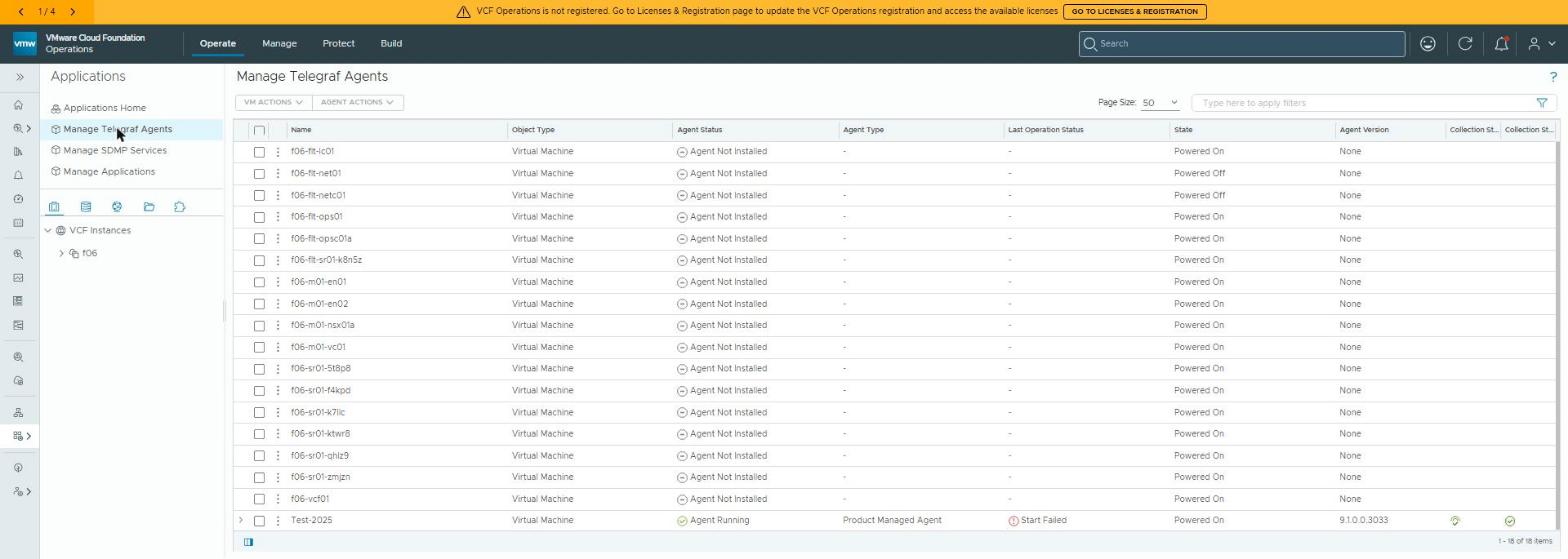 The agent list. One Windows Server 2025 VM, agent running, product-managed — and a
 Last Operation Status of “Start Failed” sitting next to a green “Agent Running”. That contradiction is the first thing you own on an unsupported OS: the start operation’s status check didn’t recognise the platform; the service came up anyway.
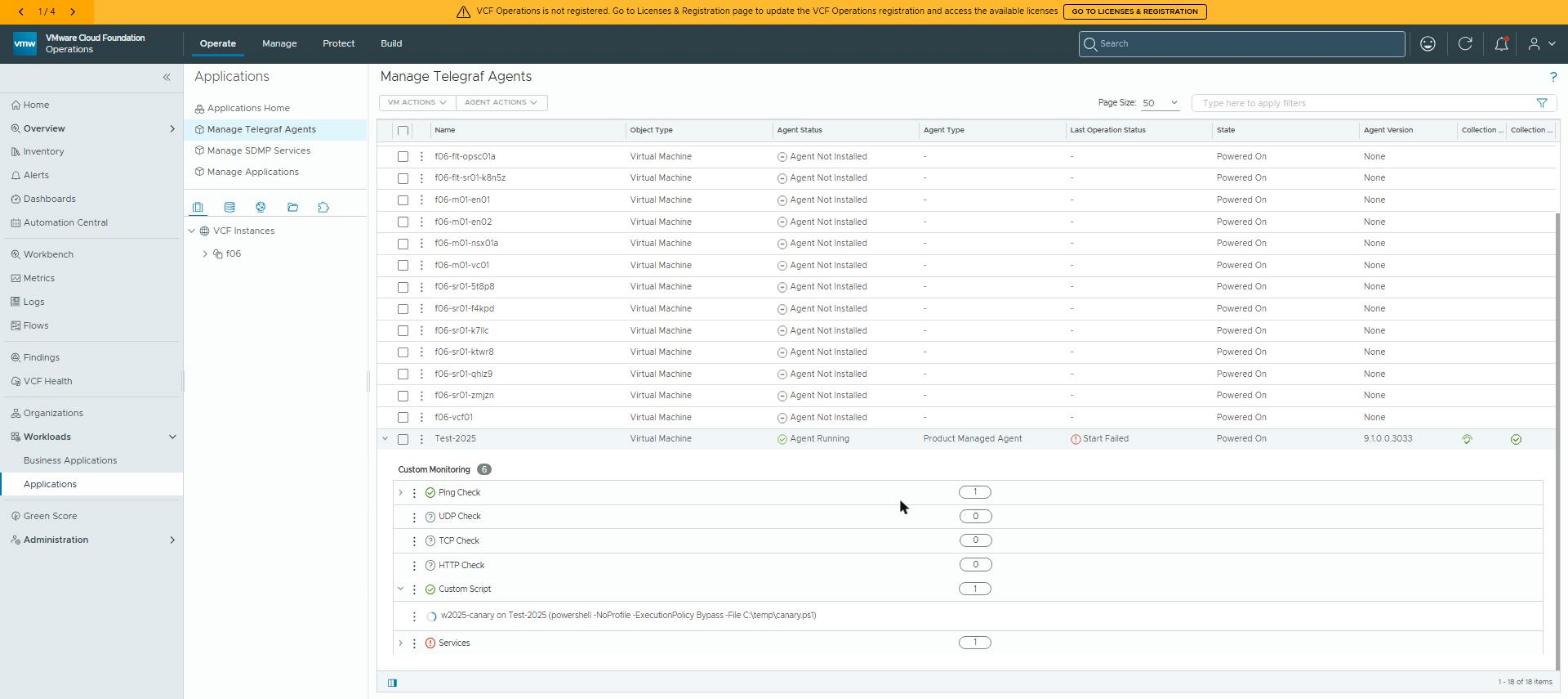 Expand the row and the agent is doing real work on an OS the matrix doesn’t list: a ping check, a service check, and the canary.
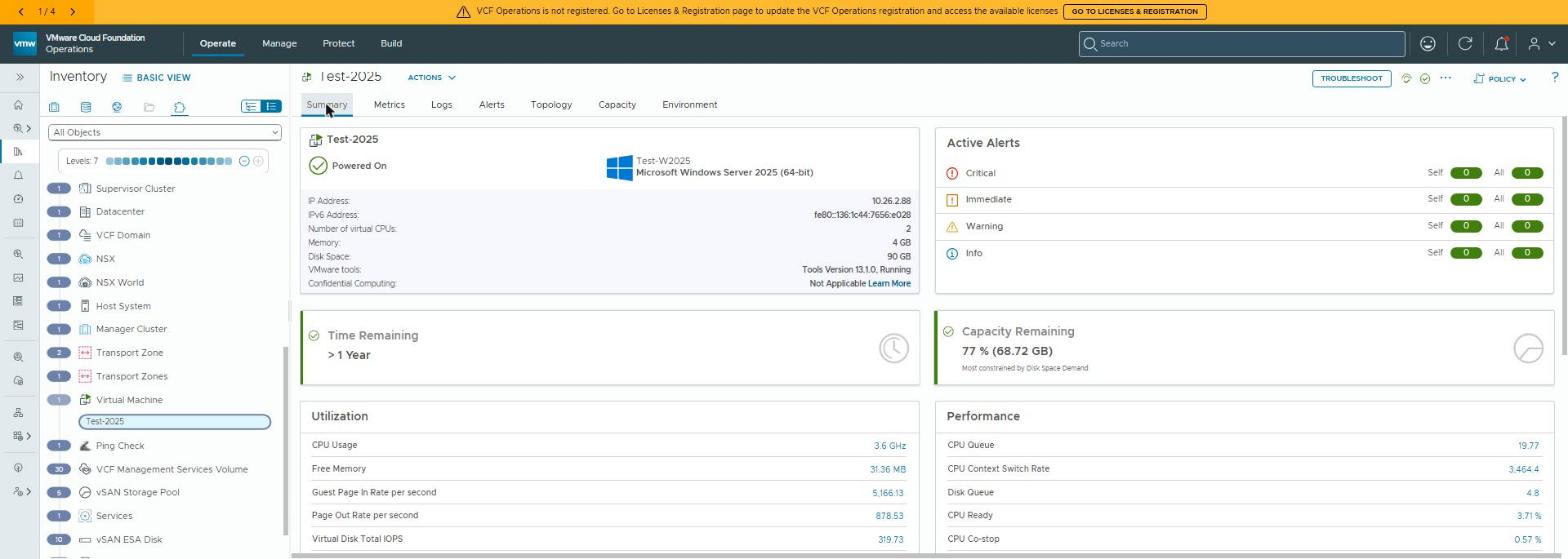
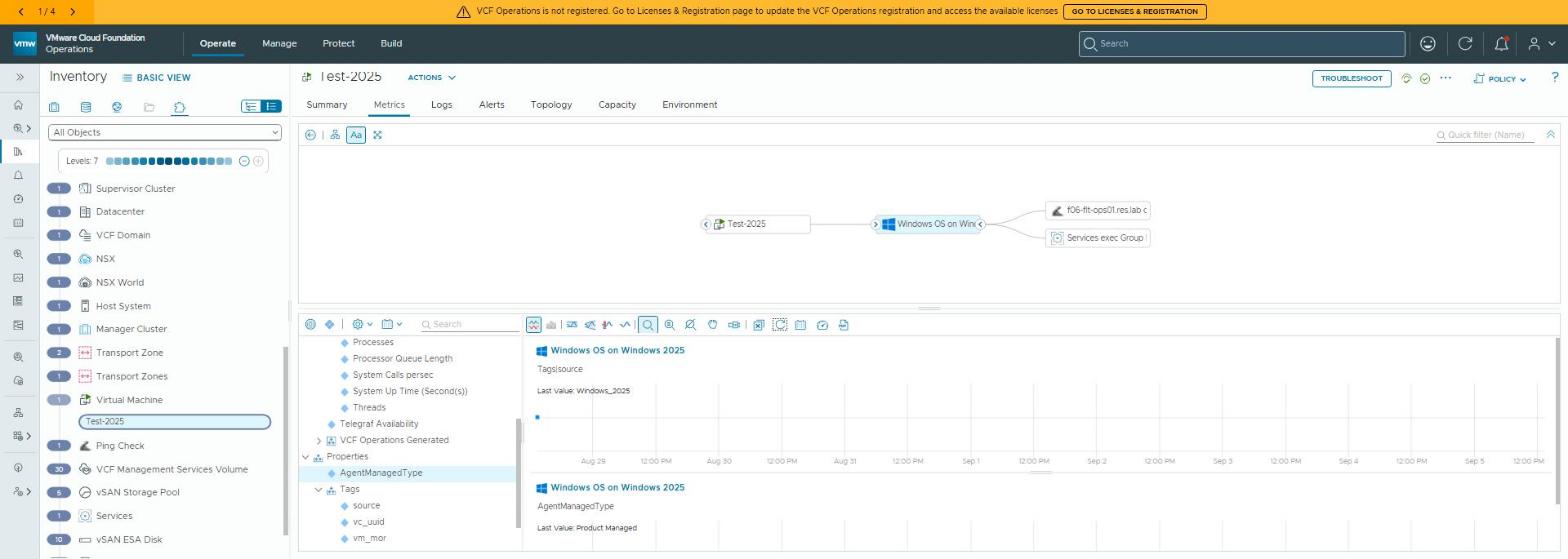 The “Windows OS on Windows 2025” child object the agent created, with
 Telegraf Availability in the metric tree and AgentManagedType reading Product Managed.
What to watch, because it’s unsupported
- Agent upgrades from Ops. The upgrade path is tested on supported OSes. Take a snapshot before pushing an agent upgrade to the W2025 fleet; upgrade one first.
- Windows cumulative updates. Performance counter names are stable; provider GUIDs occasionally aren’t. Watch the canary after Patch Tuesday.
- Service account and WinRM hardening. W2025 tightens defaults; if the install bootstrap fails it’s almost always WinRM/TLS, not the agent.
- Don’t file cases on it. Reproduce on a supported OS first. That’s the deal you made.
The same Telegraf on VKS — and its hidden dependency
On VKS the Telegraf package has a dependency that isn’t in its README:
with isMetricProxyConfigured: true it mounts two secrets
(metrics-proxy-tls-config, metrics-proxy-http-config) that only the
Supervisor Management Proxy service propagates into guest clusters. Without
the proxy installed on the supervisor, every Telegraf pod sits in
ContainerCreating / FailedMount forever, and nothing says why.
Install the proxy supervisor service, and the chain is retroactive:
SecretExport in the guest’s kube-system → SecretImport into
tanzu-system-telegraf → pods Running. (The PackageInstall needed an
annotation bump to clear a stale ReconcileFailed backoff.)
Then the second trap: Telegraf’s output URL came out as
https://supervisor-management-proxy.default.svc.:10093 — domainless and
unresolvable — because the cluster was created without
clusterNetwork.serviceDomain. Immutable. A CoreDNS rewrite rule
patched the live cluster; every new cluster gets serviceDomain: cluster.local in its spec.
Why this matters outside the lab
The practical lesson for customers is about how to adopt something the vendor hasn’t blessed yet. New operating systems arrive before support matrices catch up, and “wait” is often not an option. The approach here — run it, record exactly what you’re running, add a canary that detects breakage early, upgrade one node first — is how an operations team gets Windows Server 2025 monitored on day one without taking on hidden risk. The same discipline applies to any unsupported-but-working combination.
Rules learned
- “Unsupported” = you own the fix path. Decide that consciously, record versions, add a canary, upgrade one node first.
- The Windows inputs aren’t version-gated; W2025 runs the agent fine. Alert on metric absence, not just thresholds.
- On VKS, Telegraf hard-depends on the Supervisor Management Proxy
when the metric proxy flag is set;
FailedMounton two secrets is the tell. - Set
serviceDomainat cluster create. Every add-on that builds a service URL will thank you.
Previously: fluent-bit two ways.
Lab environment; opinions my own. Support status as observed at time of writing — check the current matrix.