
Everything was green. The VPC: realized. The namespace: ready. The VMs:
powered on, endpoints populated, ports listening. And the LoadBalancer
services sat at <pending> — for an hour.
This is the story of the least helpful error message in my recent memory, what it actually means, and the one-line ordering rule that would have saved an afternoon. If you’re doing self-service NSX VPCs on VCF 9 with the vSphere Supervisor, you will hit this. Bookmark accordingly.
The setup
Tenant-created VPC (via the VCF Automation CCI API), a supervisor namespace
pinned to it, and a couple of VirtualMachineService objects of type
LoadBalancer to publish SSH and HTTPS for the workloads inside. Standard
stuff — the exact pattern that works out of the box in the org’s default VPC.
The k8s side looked perfect:
$ kubectl get endpoints -n pod-a
NAME           ENDPOINTS                        AGE
esx01-access   172.30.0.40:443,172.30.0.40:22   6m36s
esx02-access   172.30.0.41:443,172.30.0.41:22   6m35s
Endpoints resolved. VIPs: nothing. The only clue, a recurring event:
Warning  FailedRealizeNSXResource  service/esx01-access
Generic error occurred during realizing network for Service
“Generic error.” Wonderful.
Digging: what NCP actually wants
The supervisor’s network container plugin (NCP) logs told the real story:
nsx_ujo.ncp.nsx.policy.lb_layer4_service Lb Service not Found for Namespace pod-a
NCP00270 Failed to process virtual ip for service ...: Lbs pod-a is not found
Encountered retryable error ... : Lbs pod-a is not found
NCP wants an NSX LBService in the namespace’s VPC. In the org’s
default VPC, one exists — the platform created it when the VPC was born.
In my self-service VPC? Nobody had created one. Fair enough — that’s
actually documented behaviour once you know where to look: a fresh VPC needs
a LoadBalancer object (and before that, a VPCAttachment to a
connectivity profile with the service gateway enabled, or the LB creation
itself fails with a much better error message).
So I created the attachment, then the LBService. NSX: Realized=True.
Problem solved?
Warning  FailedRealizeNSXResource  service/esx01-access
Generic error occurred during realizing network for Service
No.
The actual bug-shaped behaviour: a snapshot, not a lookup
Here’s the part that costs you the afternoon. That “retryable error” retries the lookup in NCP’s cache — not the discovery. NCP snapshots the VPC’s LB inventory when the namespace is created. An LBService that appears afterwards is never discovered, no matter how long you wait:
- Recreating the k8s services: no effect.
- Tagging the LBService with the
nsx-op/*ownership tags the working ones carry: no effect — the cache doesn’t re-read NSX. - Restarting NCP would force a full resync — but supervisor system pods are
protected; even
Administrator@vsphere.localgets a Forbidden. - Mutating the namespace to nudge a re-sync: also blocked, by the supervisor’s namespace validation webhook.
As a tenant, there is exactly one fix: delete and recreate the namespace, now that its VPC has an LB. Fifteen minutes of rebuild for want of one ordering rule.
And the control experiment proves the rule: a namespace created after its VPC already had an LBService got its VIPs assigned without any drama —
esx01-access   VIP=192.168.144.34   22 OPEN · 443 OPEN
esx02-access   VIP=192.168.144.35   22 OPEN · 443 OPEN
And once the ordering is right, this is what “working” looks like — the pod’s state a couple of minutes after a correctly-ordered deployment:
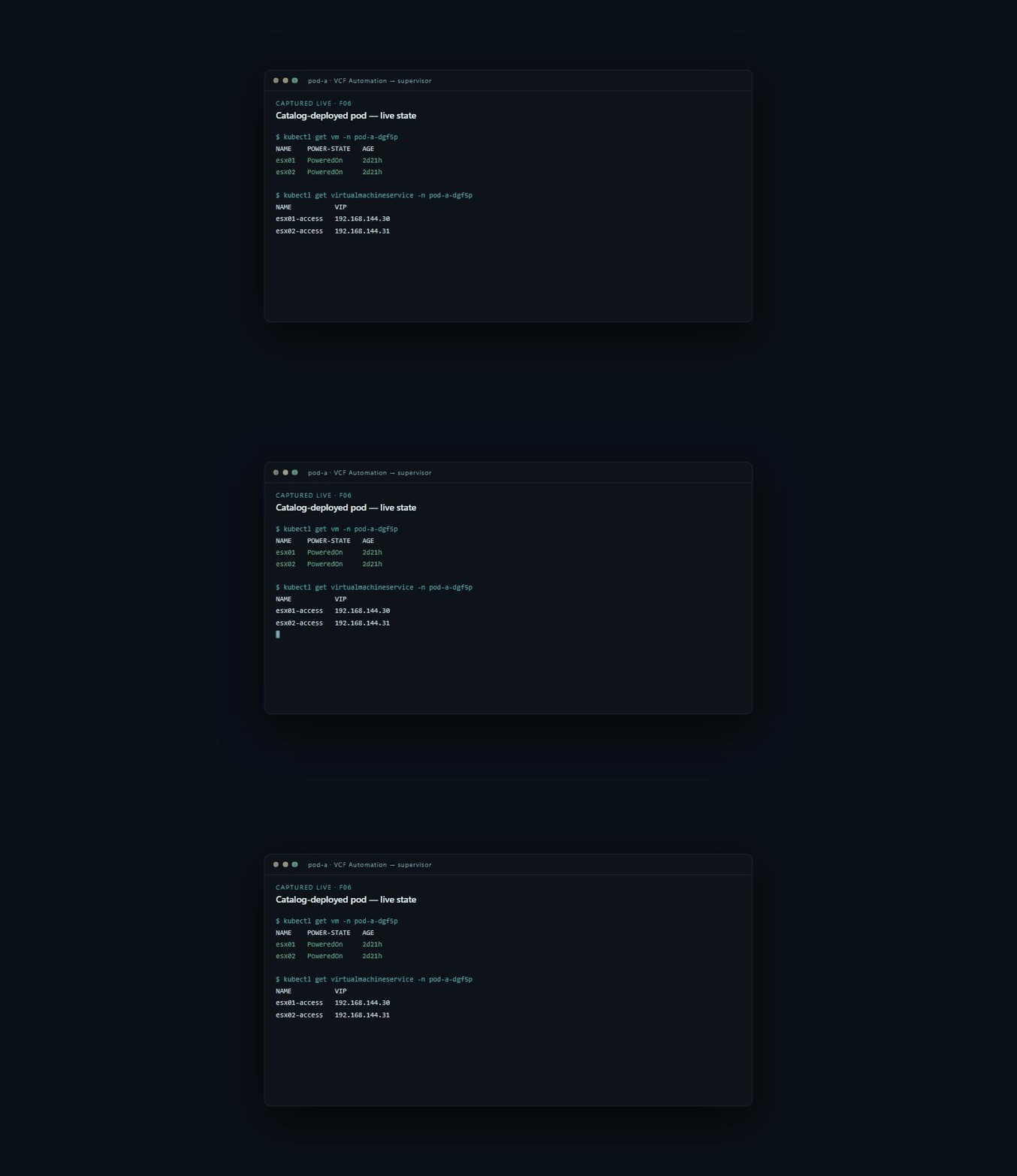
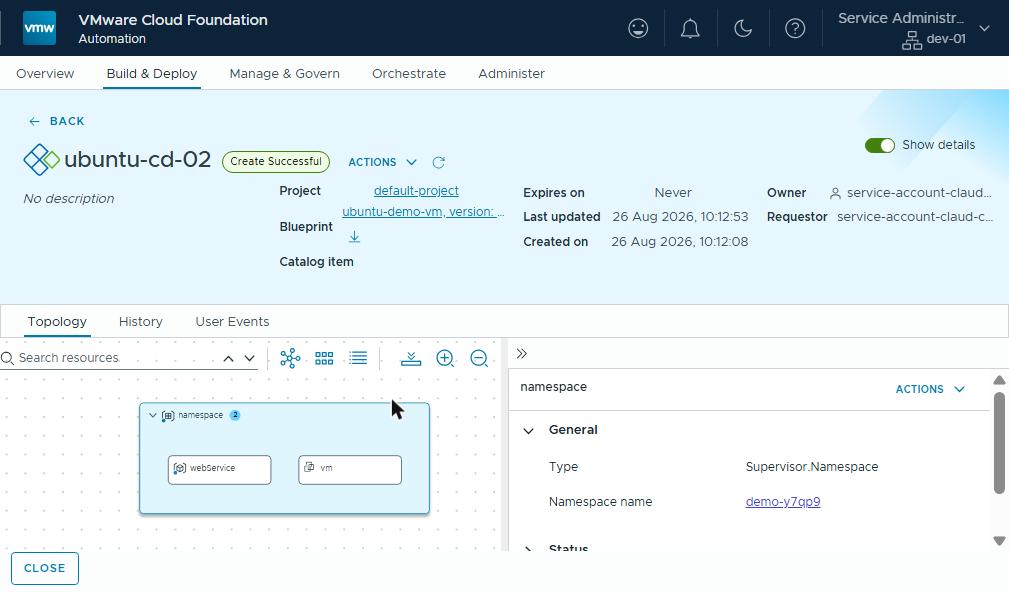 What the requester sees once the order is right.
The ordering rule
For every self-service VPC that will publish LoadBalancer services, create — in this order, before the namespace:
1. VPC                                   (vpc.nsx.vmware.com/v1alpha1)
2. VPCAttachment                         (connectivity profile w/ service gateway
                                          — LB creation errors without it)
3. LoadBalancer   {regionName, vpcName}  (the step everyone misses)
4. ...and only THEN the Supervisor Namespace
Encode it in whatever provisions your VPCs — a script, a pipeline, an
operator. It’s four API calls and it turns a silent, undiagnosable
<pending> into a platform that just works.
Why this matters outside the lab
Nobody buys a platform for its ordering rules — but this is exactly the kind
of edge that decides whether self-service provisioning feels reliable or
flaky to the people using it. In a customer deployment the answer isn’t a
blog post; it’s that the provisioning automation already does the four
steps in the right order, every time, so a tenant never sees a VIP stuck at
<pending>. Knowing where the sharp edges are — because you’ve been cut by
them in a lab — is most of what an experienced delivery partner is for.
Rules learned
- In a self-service NSX VPC, the LBService must predate the namespace. NCP discovers LBs at namespace-add and never again.
FailedRealizeNSXResource: Generic erroron a Service = go read the NCP logs; the real message (Lbs <ns> is not found, NCP00270) is there.VPCAttachment(service gateway) is the prerequisite for the LB itself — that one at least fails loudly.- Retro-tagging NSX objects to look “owned” doesn’t help a cache that never re-reads. Recreating the namespace is the only tenant-level fix.
- While you’re at it: new namespaces also reject VM creation until image
status.diskssyncs (~1–3 minutes after content library attach). Build the wait into your automation and both sharp edges disappear.
Previously in this series: nested ESXi inside an NSX VPC. Next: three datacenters, one IP plan — identical isolated pods.
Lab environment; opinions my own. Output captured live, trimmed for length, never edited for outcome.