
The Cluster manifest is the same. That’s the point of this post, and
also the punchline: VKS is VKS whichever door you walk through. What
differs is everything wrapped around the cluster — who can ask for it,
what limits it, who can see it, and how it shows up in operations tooling.
So: two clusters, one supervisor, one ClusterClass, two paths.
Path A: kubectl, the way we’ve always done it
kubectl vsphere login --server <supervisor> --tanzu-kubernetes-cluster-namespace demo
kubectl apply -f cluster.yaml
apiVersion: cluster.x-k8s.io/v1beta1
kind: Cluster
spec:
  clusterNetwork: { pods, services, serviceDomain }   # set all three — see below
  topology:
    class: builtin-generic-v3.6.0
    classNamespace: vmware-system-vks-public          # the gotcha
    version: v1.35.5+vmware.1
    controlPlane: {replicas: 1}
    workers: { one node pool, 2 replicas }
    variables: [ vmClass, storageClass ]
Fifteen minutes later: a cluster. Requires a vSphere namespace that somebody (an admin) created, with a content library attached, a VM class assigned and quota set — all in the vSphere Client, by hand.
Path B: the same manifest, as a catalog request
In All Apps the cluster is a CCI.Supervisor.Resource inside a blueprint,
sitting next to a CCI.Supervisor.Namespace:
resources:
  namespace:
    type: CCI.Supervisor.Namespace
    properties:
      generateName: ${input.name}-
      className: large                      # quota comes from the class
      regionName: f06
      vpcName: ${input.vpc}
      contentSources: [{name: f06-vks-lib01, type: ContentLibrary}]
  cluster:
    type: CCI.Supervisor.Resource
    properties:
      context: ${resource.namespace.id}
      manifest: <the SAME Cluster object as above>
Publish it, and a tenant user requests it from a tile:
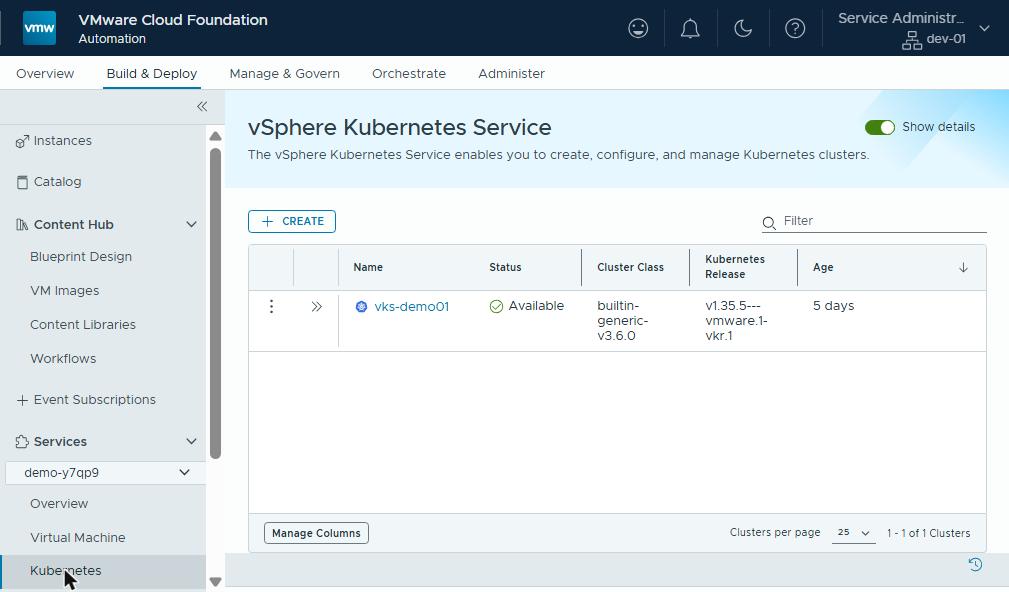
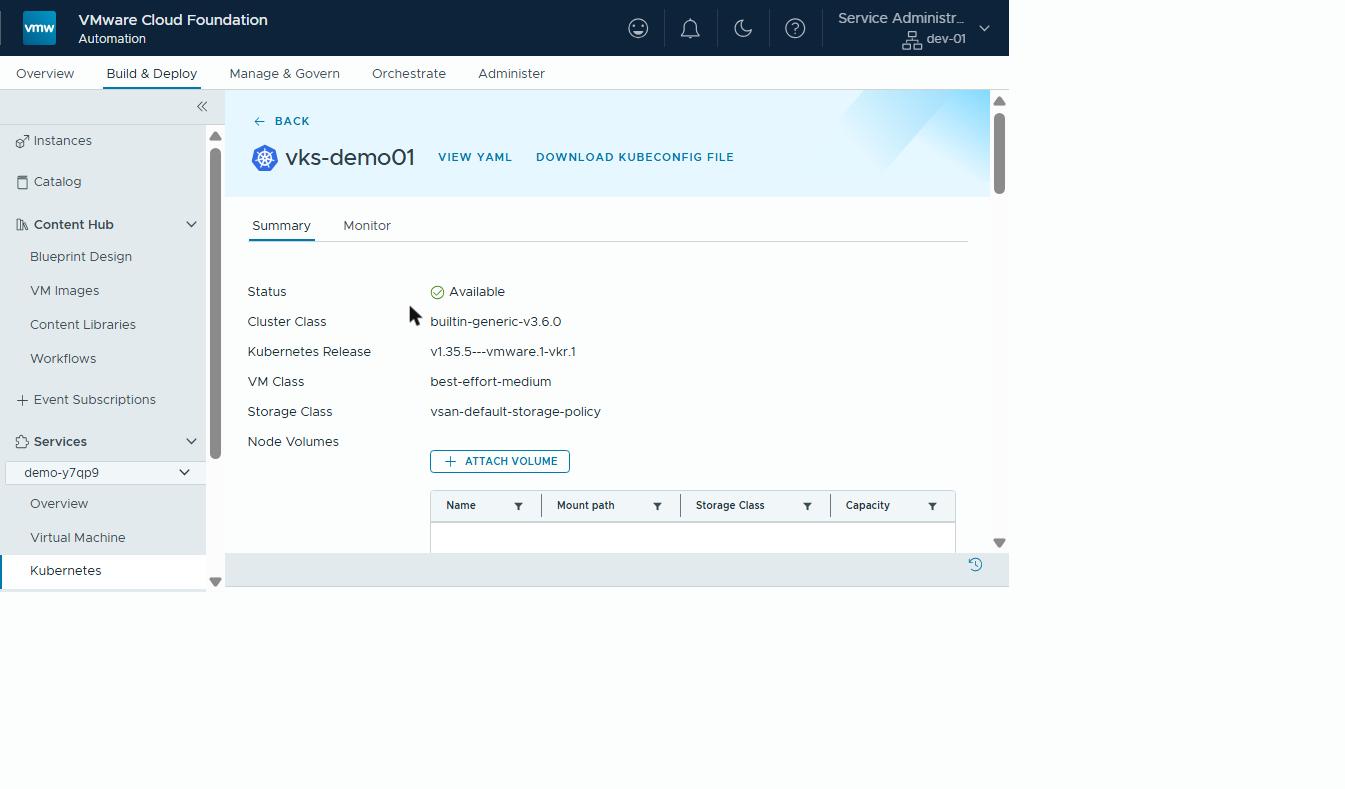
Fifteen minutes later: a cluster. Byte-identical Cluster object.
What path B adds for free
| kubectl | All Apps request | |
|---|---|---|
| Who can create | anyone with a kubeconfig to that namespace | org users with catalog entitlement (org RBAC) |
| Namespace | pre-created by an admin, by hand | created by the request, from a class |
| Quota | set per namespace in the vSphere Client | inherited from the namespace class (small/medium/large) |
| Content library | admin attaches manually | contentSources on the blueprint |
| Networking | whatever the namespace has | pinned to a tenant VPC by vpcName |
| Sizing choices | edit YAML | form inputs with enums (worker count, VM class) |
| Record | kubectl get cluster | a deployment with inputs, owner, history, day-2 actions |
| Visibility | supervisor only | VCFA inventory and VCF Operations |
That last row is the one operations teams care about:
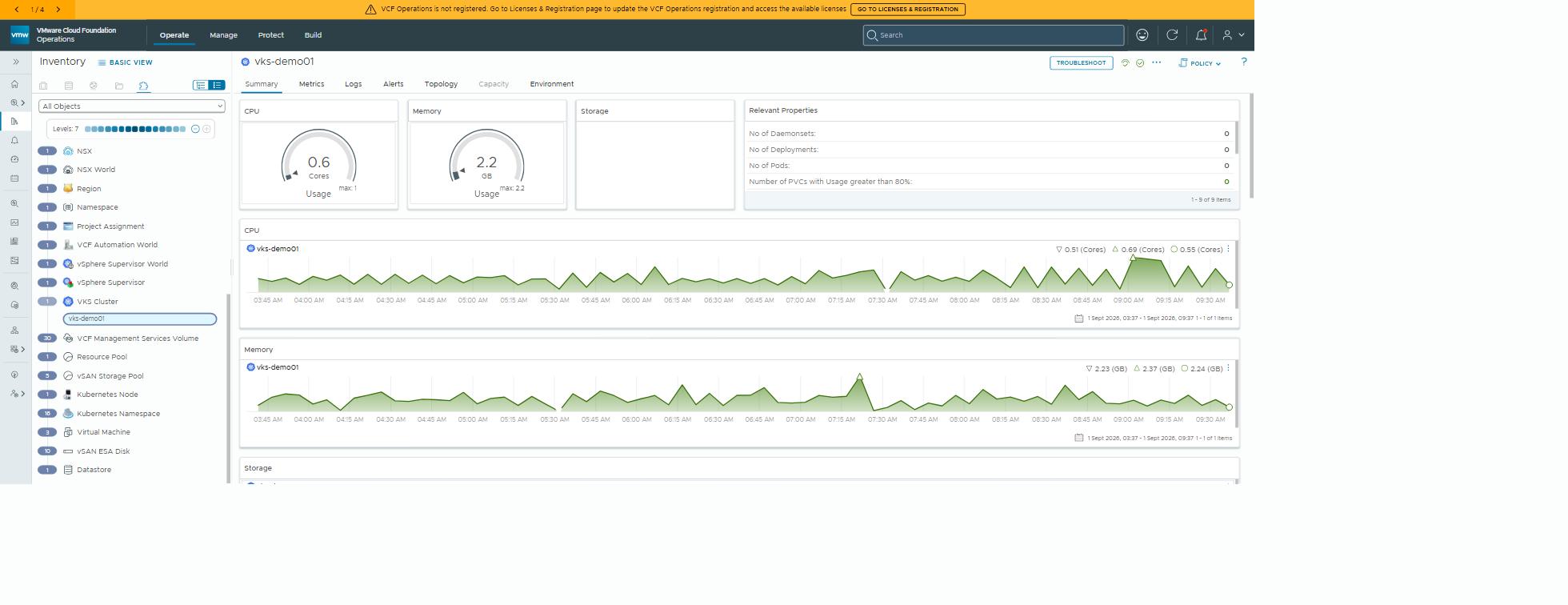
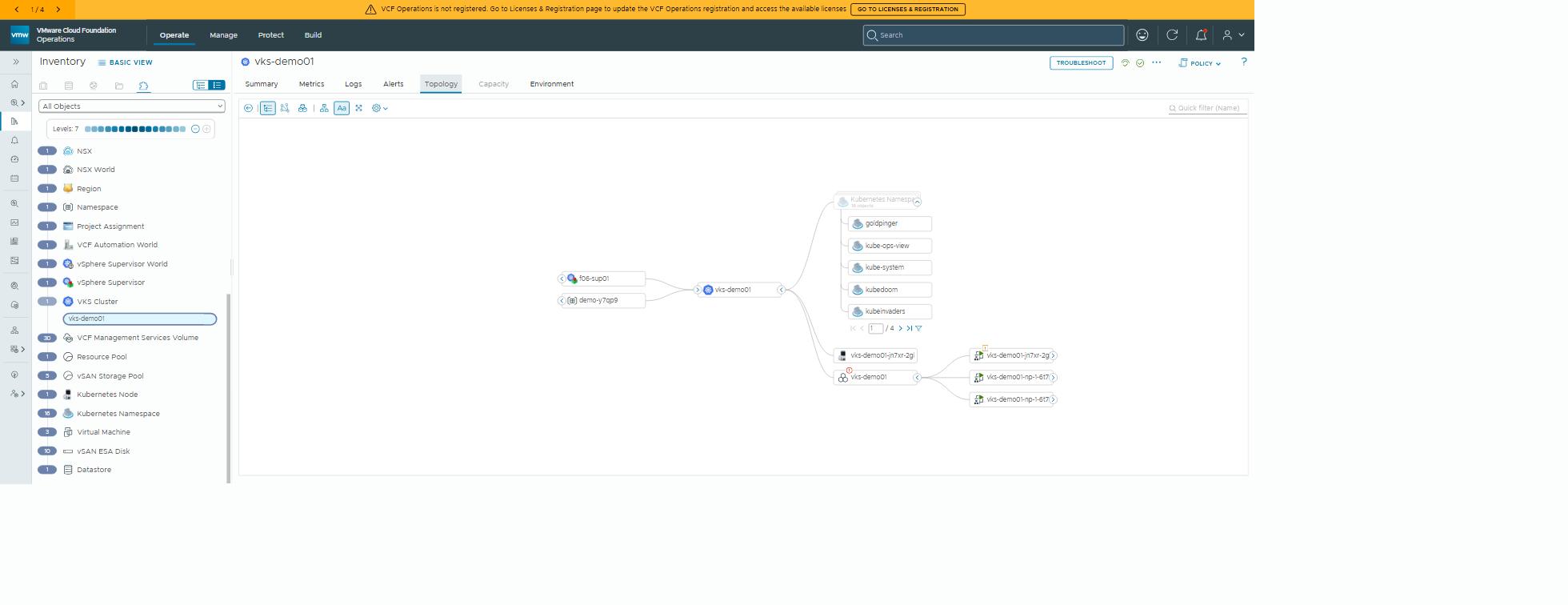
The VCFA-deployed cluster appears in Ops’ object model — supervisor → namespace → cluster → nodes → the workloads running on it — and its demo apps show up by name in the topology tab. The kubectl-built cluster is also visible to Ops (it’s the same supervisor, after all), but it has no deployment, no owner, no request history and no quota lineage. It’s a thing that exists, not a thing that was provided.
The four gotchas, in order of how much time they cost
Both paths share the same four traps on VKS 1.35 / VCF 9.1:
- A VCFA-created namespace has no content library. Zero
VirtualMachineImages → no cluster possible.contentSourcesin the blueprint, or attach by hand. ClusterClasslives invmware-system-vks-public. It 404s from the workload namespace unless the spec setstopology.classNamespace.- The default Quick Start namespace is 1000M CPU / 1000Mi. Unusable
for a cluster. Use a real class:
small10000M/10000Mi,medium20000M,large40000M. - VKS 1.35 enforces PodSecurity
restrictedby default. Demo apps that run as root get a ReplicaSet and no pods; the events sayFailedCreate. Label the app namespacepod-security.kubernetes.io/enforce=privileged(or fix the apps).
Plus one that only shows up later: set clusterNetwork.serviceDomain
explicitly. It’s immutable after create, and a cluster without it produces
a service DNS name that some add-ons build wrongly (....svc. with no
domain). And pick a pod CIDR that doesn’t shadow your VPC’s external range
— the stock 192.168.0.0/16 hid the org’s 192.168.144.0/21 from inside
the cluster.
So which one?
Use kubectl when you’re the platform team proving something on a supervisor, or debugging. Use All Apps the moment a second person needs a cluster: the request form is the interface, the namespace class is the guardrail, the deployment is the audit trail, and Ops sees it as a provided service rather than a stray object.
The cluster’s the same either way. The service isn’t.
Why this matters outside the lab
The business case for the second path is governance without friction. Development teams get Kubernetes clusters on request; the platform team gets quotas, ownership, RBAC and a monitoring view of every cluster for free. That’s the difference between a managed Kubernetes service and a collection of clusters nobody can account for — and it’s typically the gap that stops organisations offering Kubernetes broadly at all. Everything the developers touch stays standard Kubernetes; the control lands around it, not on it.
Rules learned
- The
Clusterobject is identical across paths — All Apps wraps it, it doesn’t change it. - What All Apps adds: catalog RBAC, class-based quota, library attach, VPC pinning, deployment history, and a place in the Ops object model.
- Four traps on 1.35: no default library,
classNamespace, tiny default quota, PodSecurityrestricted. - Set
serviceDomainand a non-shadowing pod CIDR at create; both are immutable.
Next in All Apps in Practice: the demo apps that live on this cluster.
Lab environment; opinions my own.