
The second trap from part 1 deserves its own short post, because it catches everything, not just ESXi: a VPC subnet has DHCP deactivated. Drop a stock appliance onto one and it will boot, sit at “waiting for DHCP”, and wait politely until the heat death of the universe.
This isn’t a gap. It’s the model: NSX allocates the address at the port and pins it there with address bindings; the guest has to be told what it was given. The VM Service does that telling through bootstrap providers, and once you know the three of them, static addressing stops being a chore and starts being a feature.
Three providers, three guest types
| Guest | Provider | Carries |
|---|---|---|
| Linux | cloudInit | user-data (users, write_files, runcmd) + network config |
| Windows | sysprep | unattend XML / sysprep spec, identity, network |
| Appliances (OVF) | vAppConfig | OVF properties (guestinfo.*) the appliance reads on boot |
All three are typed fields on the VirtualMachine object, not bolt-on
customisation specs. The network side is already known to the platform —
the VM Service knows which subnet each interface landed on and what NSX
allocated — so for cloud-init and sysprep the addressing is injected for
you. Appliances are the exception, because each one has its own idea of
which properties it wants.
Appliances: vAppConfig
The nested-ESXi appliance reads guestinfo.* OVF properties. In the VM
Service spec that’s:
bootstrap:
  vAppConfig:
    properties:
      - {key: guestinfo.hostname,  value: {value: "esx01.pod-a.res.lab"}}
      - {key: guestinfo.ipaddress, value: {value: "172.30.0.40"}}
      - {key: guestinfo.netmask,   value: {value: "255.255.255.224"}}
      - {key: guestinfo.gateway,   value: {value: "172.30.0.33"}}
      - {key: guestinfo.vlan,      value: {value: "1610"}}
      - {key: guestinfo.dns,       value: {value: "10.20.52.1"}}
      - {key: guestinfo.ssh,       value: {value: "True"}}
The one that trips people: the address you give must be the one NSX
allocated to the port. In a standard subnet that’s enforced by
SpoofGuard; on a trunk subnet the VLAN subnets have their own allocations
and you’re choosing addresses within them. Either way, pick from the
realized range — and remember recreating a VM reallocates its
addresses, so the fixed .40/.41 in a
deterministic pod is a design
choice, not luck.
Linux: cloud-init
A Secret holding user-data, referenced from the VM:
bootstrap:
  cloudInit:
    cloudConfig:
      users: [ ... a local user with a key ... ]
      write_files:
        - path: /var/www/html/index.html
          content: "shared-svc repo01\n"
      runcmd:
        - [systemctl, enable, --now, nginx]
Networking arrives via the platform’s own network-config; you don’t
write it. The svc-repo01 VM from the shared-services
post was exactly this —
write_files + runcmd, web page verified from three pods.
Windows: sysprep
bootstrap:
  sysprep:
    sysprep:
      guiUnattended: {autoLogon: true, autoLogonCount: 1, timeZone: 85}
      identification: {joinWorkgroup: WORKGROUP}
      userData: {fullName: Lab, orgName: Lab, computerName: {name: win01}}
Or rawSysprep with an unattend XML in a Secret if you already have one.
The ISO from the blueprint post
can ride along as a declarative hardware.cdrom — handy for tools and
agents on first boot.
The ESXi footnote: one gateway, many vmks
Once the appliance is up and you add vMotion and vSAN vmks on their own subnets, you hit a detail that makes the Host Client look wrong:
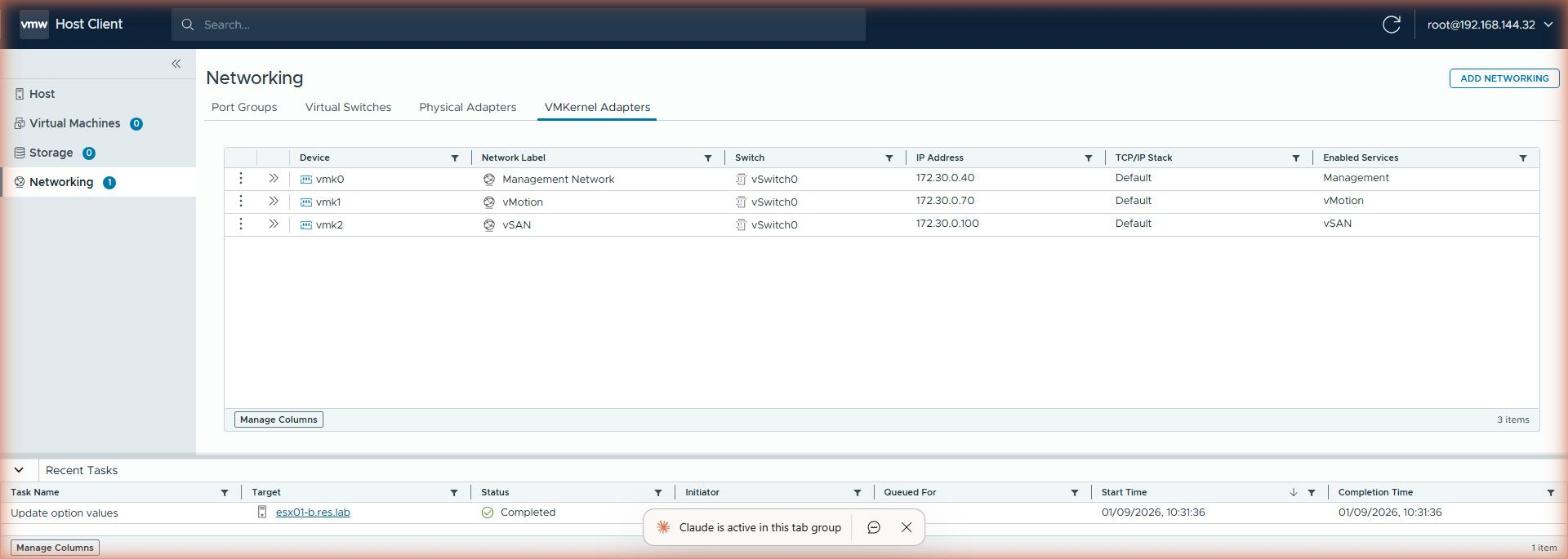
ESXi’s default TCP/IP stack has one default gateway — vmk0’s .33 —
and the UI repeats it on every vmk row. Same-subnet vMotion never uses a
gateway so nothing breaks, but each NSX subnet does have its own
gateway, and cross-subnet traffic from vmk1/vmk2 would take the wrong exit.
Set per-vmk override gateways:
esxcli network ip interface ipv4 set -i vmk1 -t static -I 172.30.0.70  -N 255.255.255.224 -g 172.30.0.65
esxcli network ip interface ipv4 set -i vmk2 -t static -I 172.30.0.100 -N 255.255.255.224 -g 172.30.0.97
Now the display is truthful and the routing is correct. (The full-realism
alternative is a dedicated vmotion netstack for vmk1; I kept the default
stack so the service tags stay visible in the Host Client.)
Why this matters outside the lab
For the business, “no DHCP” translates into something security and operations teams both want: predictable addressing. Every environment has a known address plan, firewall rules can be written once, and nothing turns up on the network with an address nobody expected. Bootstrap providers deliver the second benefit — images stay generic and configuration is injected at deploy time, so there are fewer golden images to maintain and far less drift between environments.
Rules learned
- No DHCP in VPC subnets — by design. NSX allocates at the port; the guest is told via a bootstrap provider.
cloudInit(Linux),sysprep(Windows),vAppConfig(appliances) — typed fields on the VM, not customisation specs.- Appliance addresses must match the realized subnet; fix the order of subnet creation if you want fixed addresses across pods.
- ESXi has one default gateway per stack. Set
-gper vmk, or the Host Client lies to you and cross-subnet traffic exits wrong. - A static IP plan is a feature in a lab: it’s what makes screenshots, runbooks and pods identical.
Companion to nested ESXi inside an NSX VPC.
Lab environment; opinions my own.