
Part 1 ended with a startup scheduled
task registered and 05-build-master.ps1 staged locally. From this point
the machine will reboot at least twice more — Windows Updates insists, and
the build ends with a clean reboot — and every one of those boots runs the
same script. The script has to converge on a finished build no matter how
many times it’s invoked.
That’s a state machine, and it’s built from three very boring mechanisms.
The three mechanisms
1. Master kill switch. If 100_build_complete.flag exists, exit
immediately. A stray task run after completion does nothing.
2. Per-step flags. Every install step writes
NN_<Step>_installed.flag on success and is skipped on subsequent runs.
3. Persisted state. data-state.json holds the provisioning start
time and per-step timings, re-loaded on every boot. So the final report
shows the true duration of every step across the whole build, not just
the last boot — and a step re-observed as SKIPPED after a reboot never
overwrites its real recorded duration.
every boot:
  if 100_build_complete.flag → exit
  load data-state.json
  for step in $softwarePayload:
      if NN_step_installed.flag → SKIP (keep recorded timing)
      run installer from local Staging (timeout ceiling)
      exit 0 or 3010 → write flag, record timing
      if step.RebootAfter → Restart-Computer; exit      ← next boot resumes here
  cleanup → validate → publish → self-destruct → final reboot
Phase 1: software, declaratively
The stack is a single array — the designed extension point:
$softwarePayload = @(
  @{ Name='MonitoringAgent'; Folder=$p.monPath;  File=$p.monInstallFile;  Timeout=20; Reboot=$false;
     Service='HealthService';       Path='...\Monitoring Agent\HealthService.exe' },
  @{ Name='InventoryAgent';  Folder=$p.invPath;  File=$p.invInstallFile;  Timeout=15; Reboot=$false;
     Service='InventoryAgent';      Path='...\Inventory\agent.exe' },
  @{ Name='EndpointSecurity';Folder=$p.epsPath;  File=$p.epsInstallFile;  Timeout=30; Reboot=$false;
     Service='masvc';               Path='...\Agent\masvc.exe' },
  @{ Name='LogAgent';        Folder=$p.logPath;  File=$p.logInstallFile;  Timeout=15; Reboot=$false;
     Service='LogAgentService';     Path='...\Log Agent\liwinsvc.exe' },
  @{ Name='WindowsUpdates';  Folder=$p.updPath;  File=$p.updInstallFile;  Timeout=45; Reboot=$true }
)
Adding a product is adding an element. Each installer runs from the local
staging copy with a hung-installer timeout; exit codes 0 and 3010
(success, reboot required) count as success. When a Reboot=$true step
succeeds, the script restarts the machine and exits; on the next boot the
task re-runs it, completed steps skip via their flags, execution resumes at
the next step.
Post-install health isn’t “installer said OK” — it’s flag present AND service running AND install path exists, with a 120-second wait for delayed-start services. Windows Updates is flag-only; there’s no service to check.
Phase 2: cleanup — leave nothing behind
- Eject the config-drive ISO. In Session 0 there’s no Explorer, so
the usual shell ejection doesn’t work. A P/Invoke to
winmm’smciSendString("set cdaudio door open")does. - Restore UAC.
EnableLUAandFilterAdministratorTokenwere relaxed in the base image so the build could run unattended; re-enable both. - Uninstall cloudbase-init. Stop and delete the service, kill its
processes, run the uninstaller silently, remove the directory. Guarded
by
99_cleanup_complete.flag.
The startup task is deleted before validation, so the health check can truthfully report “no automation task remains”.
Phase 3: collect the evidence
The script assembles data-validation.json — the single input to the
report in part 3:
| Collector | Captures |
|---|---|
| Network | per active adapter: alias, IPv4, prefix, gateway, MAC, DNS |
| Infrastructure | guestinfo.vra.infrastructure via vmtoolsd, 15 attempts × 10 s (the vRO subscription can land late) |
| OS / hardware | domain, CPUs, RAM, caption, uptime, time zone, pending reboot, latest hotfix |
| AD / security | local Administrators, secure-channel test, machine OU |
| Disks | per volume: letter, label, size, free |
| Post-build health | WinRM, RDP, UAC enabled, startup task gone, domain DNS resolves, NTP source |
| Software | per app: flag + service + path |
| Installed apps | both uninstall hives (64-bit and WOW6432) |
The verdict is strict: GuestStatus = Success only if every software
item is healthy and the machine is domain-joined. Anything else renders
the report banner red.
Phases 4 and 5: publish, then self-destruct
Remap the share with the write account (5 × 10 s retries — a
different account from the read-only one used for pulls; a compromised
build guest can’t tamper with the engine). Render the HTML report locally.
Write 100_build_complete.flag — kill switch armed. Copy the report plus
Data\, Flags\, Logs\ to \\share\Builds\<image>\<HOSTNAME>\. Stop the
transcript before copying logs so the final log is complete and unlocked.
Then: delete the startup task; overwrite both share passwords in the
on-disk payload with *** SCRUBBED ***; delete Data\ and Staging\
(and Flags\/Logs\ if the share copy succeeded); delete the sibling
scripts and itself; remove Scripts\; reboot one final time.
The delivered server boots clean, domain-joined, agents running, and carries no credentials, payloads or tooling.
The reboot sequence of a nominal build
- After static networking (
00, exit 1003) - After engine pull (
03, exit 1003) — ends the cloudbase-init phase - After Windows Updates (
05,Reboot=$true) - Final, after publish and self-destruct
The report’s timeline chart finds the update reboot automatically: any gap over 30 seconds between steps is shaded and labelled REBOOT.
At completion the Flags\ folder is the whole history of the build in
file names:
Flags  00_config-network.flag
  01_config-disks.flag
  02_join-domain.flag
  03_init-puller.flag
  04_stage-payloads.flag
  01_MonitoringAgent_installed.flag
  02_InventoryAgent_installed.flag
  03_EndpointSecurity_installed.flag
  04_LogAgent_installed.flag
  05_WindowsUpdates_installed.flag
  99_cleanup_complete.flag
  100_build_complete.flag        <- kill switch
And the persisted timings turn into this, in the report from part 3:
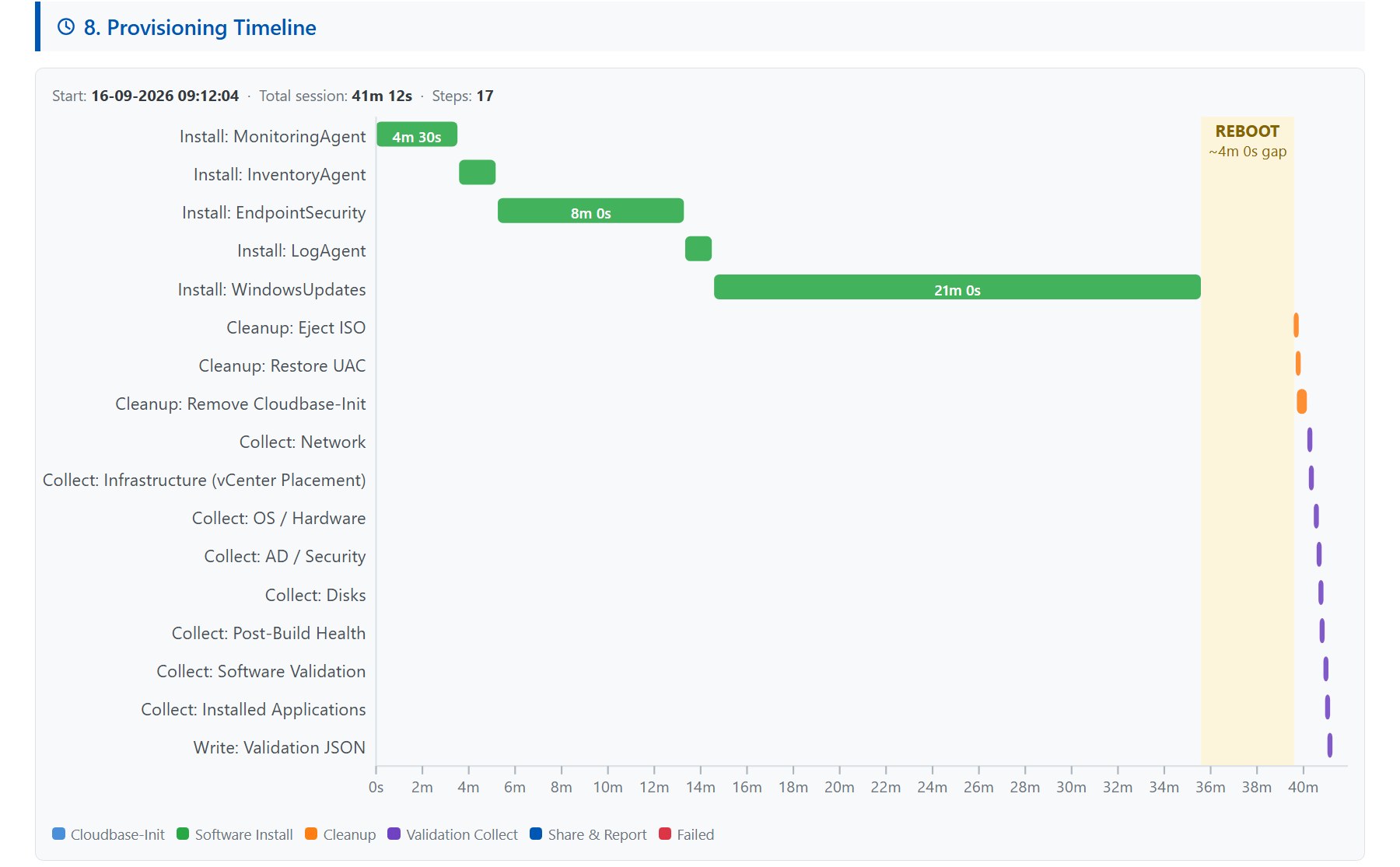 Every bar sits at its true wall-clock position across the reboots because the state file carried the timings. The amber band is the reboot after Windows Updates, found automatically from the gap.
Why this matters outside the lab
What customers get from a reboot-safe build is predictability: every server takes the same steps in the same order, survives the reboots Windows insists on, and finishes clean — with no tooling, no credentials and no leftover tasks on the delivered machine. That last part matters to security reviewers as much as the first part matters to operations. And because every step’s timing is recorded, “why did this build take twice as long?” has an answer instead of a guess.
Rules learned
- A reboot-safe build is kill switch + per-step flags + persisted timings. Nothing cleverer is needed.
- Treat exit 3010 as success. Let the step declare whether to reboot; the loop handles it.
- Health = flag and service and path. Installer exit codes lie.
- Read platform-injected metadata with retries — the injecting workflow may land after the guest starts looking.
- Two share accounts: read-only for pulls, write-only for publishing.
- Delete the task before validating, so “no task remains” is checkable.
- Stop the transcript before you copy the logs.
- Scrub, delete yourself, reboot. The customer gets a server, not a build environment.
Part 3: validation as a product, and the details that hurt.
Lab write-up of a production pattern; customer specifics removed. Opinions my own.