
Most provisioning pipelines end with “Deployment completed”. This one ends with a document a human can read, and it changed how the platform team and the server team talk to each other: instead of “it’s built, go check it”, the requester gets a page that says what was built, where it landed, what passed, and how long each step took.
Part 1 was the architecture; part 2 the state machine. This is the payoff — and then the details that were nowhere in any documentation.
The report
06-validate-build.ps1 is a pure transformation: data-validation.json
in, one self-contained HTML file out. No server, no external assets — CSS,
SVG icons and the timeline chart are all inline — so it opens from the file
share or as an email attachment as-is.
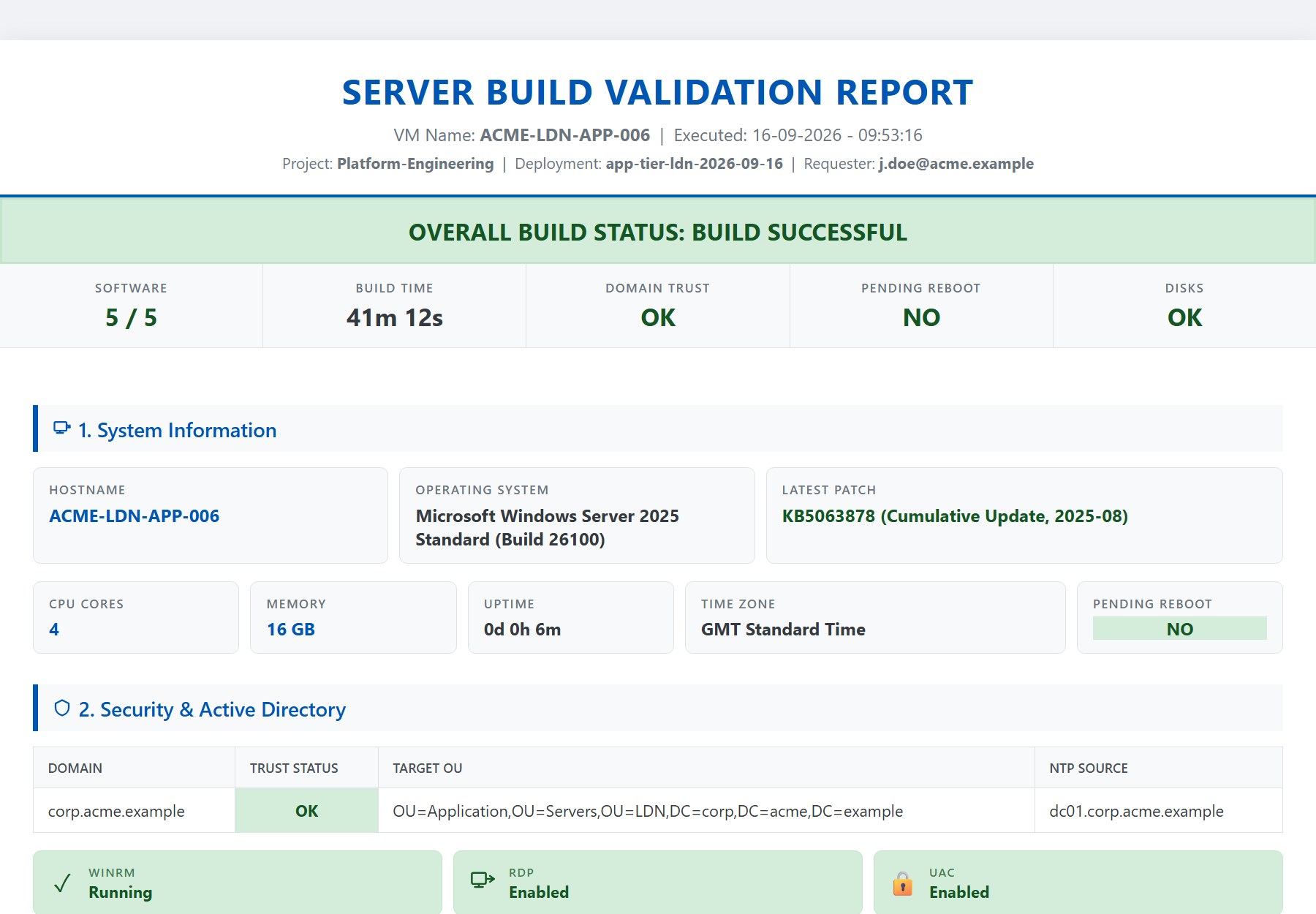 The top of the report. Rendered by the real renderer from an anonymised payload: the hostnames, domain and vendor names are fictional, the code that drew it is not. Open the full report — it’s one self-contained HTML file — or the JSON it was built from.
Header: VM, execution time, project, deployment, requester. Banner: BUILD SUCCESSFUL / BUILD FAILED per the strict rule from part 2. A sticky status bar keeps hostname and verdict visible while scrolling. Then:
| Section | Contents |
|---|---|
| System | hostname, OS, latest patch, CPU, RAM, uptime, time zone, pending reboot |
| Security & AD | domain, trust status, OU, NTP source; WinRM/RDP/UAC status cards; local admins |
| Software | one card per agent: pass/fail badge + the individual checks (flag, service, path) |
| Network | per adapter: alias, MAC, IP, mask (converted from prefix), gateway — joined to the vSphere portgroup via the guestinfo NIC/MAC map |
| Storage | per volume: capacity bars (warn < 20 % free, critical < 10 %) + backing datastore chips |
| Tags | every deployment tag as a colour chip (palette chosen deterministically by key hash, so the same tag is always the same colour) |
| Placement | vCenter → datacenter → cluster → host chain, VM folder; “metadata pending” if guestinfo was never readable |
| Timeline | SVG Gantt of every step at true wall-clock position; phase colours; automatic REBOOT detection (gaps > 30 s shaded and labelled) |
| Installed apps | collapsible full inventory |
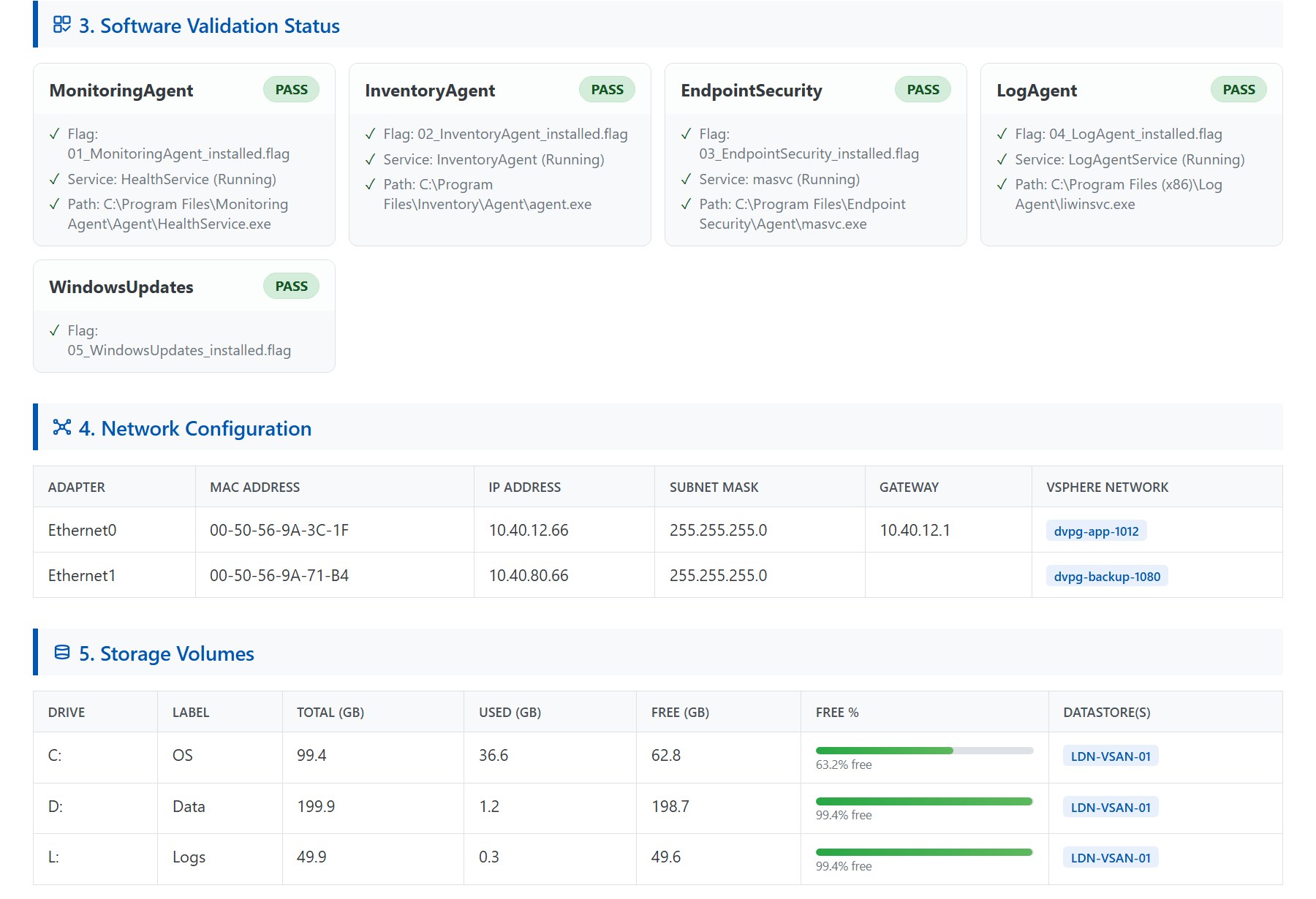 Sections 3 to 5: one card per agent with its three checks; adapters joined to their portgroups; volumes with their backing datastore.
The network table is the one that gets the “oh” reaction: the guest knows its adapters, vCenter knows the portgroups, and the guestinfo bridge from part 1 lets one table show both, joined on MAC, with no credentials crossing the boundary.
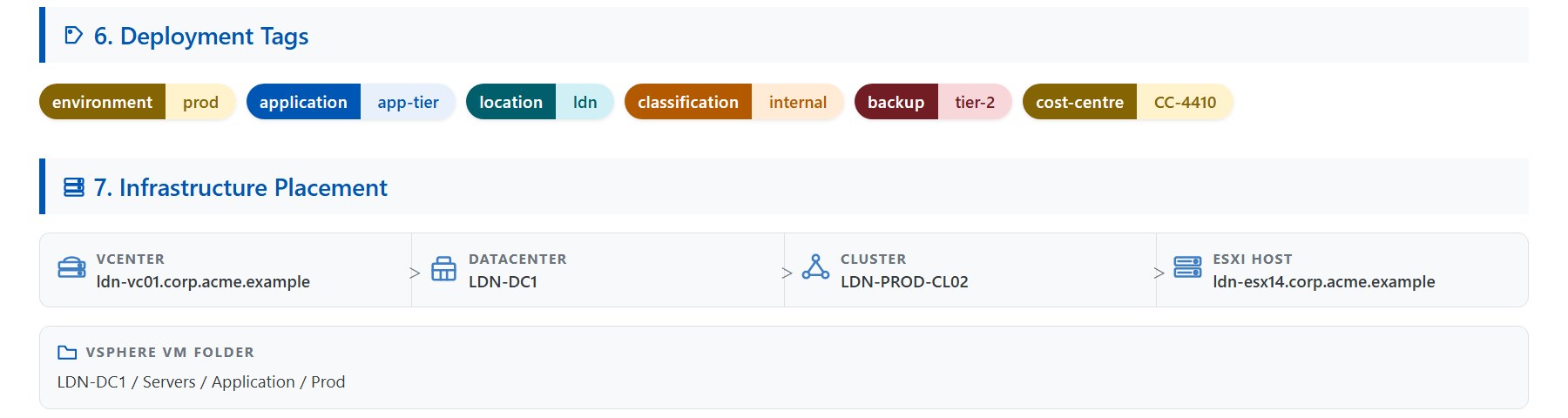 Tags and placement — all of it from the request and from
 guestinfo, none of it from a credential in the guest.
The Gantt is the one operations teams use. When a build takes 90 minutes instead of 40, the chart shows whether it was the updates step, a slow installer, or a 20-minute gap where the machine sat at a boot prompt.
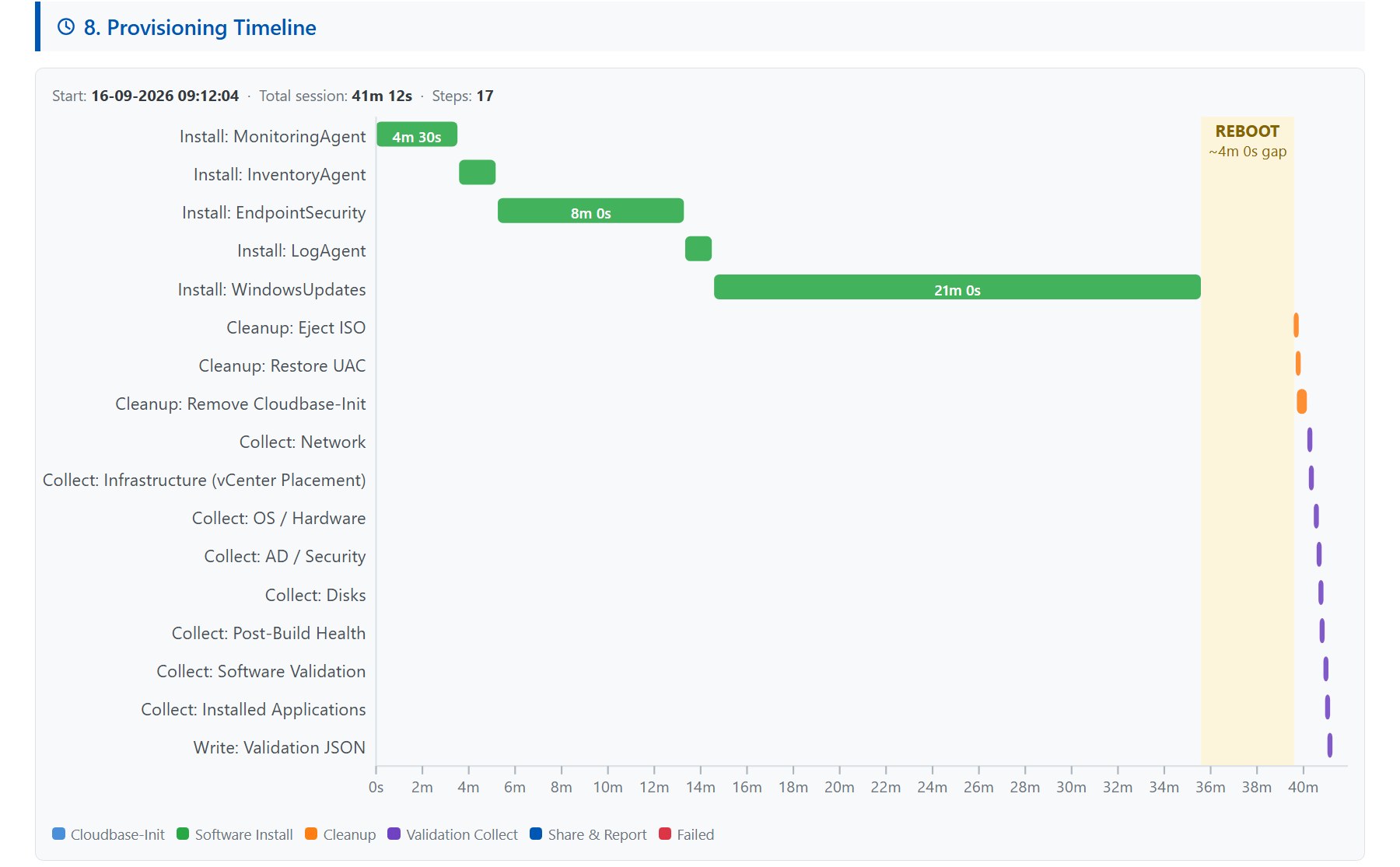 Section 8. Phase colours, true wall-clock positions, and the reboot detected from a gap over 30 seconds — nothing logged “rebooting now”.
The details that hurt
Every one of these cost hours and none of them is in a manual.
vmtoolsd mangles arguments under SYSTEM in Session 0
Reading guestinfo.vra.infrastructure via
& vmtoolsd.exe --cmd "info-get guestinfo.vra.infrastructure" works
interactively and fails silently as SYSTEM in a startup task: the
argument quoting gets mangled on the way through. Fix: build the process
explicitly with System.Diagnostics.Process, set Arguments as one
string, redirect stdout, and read it yourself. Also: retry — 15 × 10 s —
because the vRO subscription that writes the value can land after the
guest starts looking.
Ejecting an ISO with no Explorer
Session 0 has no shell, so Shell.Application ejection does nothing. A
P/Invoke to winmm.dll:
[mciSend]::mciSendString("set cdaudio door open", $null, 0, [IntPtr]::Zero)
opens the tray. It feels like 1998. It works.
Exit 1003 is the only reboot you should ever request from cloudbase-init
Call Restart-Computer from a cloudbase-init script and you race the
plugin’s own state tracking. Exit 1003 instead: cloudbase-init reboots,
re-runs the part on next boot, and your flag file short-circuits it.
Installers’ 3010 is a different animal — that’s “success, reboot
wanted” and the build master decides when.
cloudbase-init has to remove itself
Leaving cloudbase-init installed on a delivered server is an unattended execution surface: anyone who can present a config drive owns the box. The cleanup phase stops the service, kills the processes, runs the uninstaller silently and deletes the directory — and does it before validation, so the report can confirm it’s gone.
UAC was off. Turn it back on.
The base image relaxes EnableLUA and FilterAdministratorToken so the
build runs without prompts. If the cleanup forgets to restore them you
ship a server with UAC disabled and a report that says SUCCESS. The
“UAC enabled” card in the security section exists so this can never be
silent.
Secrets: encrypt to the machine, then scrub
The two share passwords are the only secrets that ever touch guest disk.
They’re AES-encrypted with a key derived from the BIOS UUID
(Win32_ComputerSystemProduct.UUID) — useless off-box — decrypted only in
memory, and overwritten with *** SCRUBBED *** before the final reboot.
That’s containment appropriate to a transient build secret; it’s not a
vault, and shouldn’t be described as one.
The requester is told too early
The “your deployment completed” email fires at Compute Post Provision — when vCenter has finished, not when the guest has. Users open a server that’s mid-Windows-Updates. Move it to a deployment-completion topic, or at minimum include the report’s future share path.
Hostname allocation has a race
Read-then-allocate against AD is unsynchronised: two concurrent
deployments can observe the same highest suffix and pick the same name.
Within one multi-machine deployment the count-based batch is safe; across
deployments, wrap the search-and-generate in a vRO LockingSystem lock.
What I’d carry to any build pipeline
Strip the Windows specifics and five ideas survive:
- The report is the deliverable. Build it from a single JSON document so it’s testable without a build.
- Join guest facts to platform facts via a one-way metadata channel.
- Detect reboots from timing gaps, not from logging “rebooting now”.
- Health is three checks, never the installer’s exit code.
- Clean up before you validate, so “clean” is a checkable claim.
Why this matters outside the lab
The report is the part customers remember. It replaces “your server is ready” with evidence: what was installed and whether it’s healthy, where the server landed in vCenter, how the network was configured, how long each step took and where the reboots were. Service desks use it to close the request, security teams use it to confirm the controls, and platform teams use the timeline to spot regressions. The same idea — validate, then publish proof — transfers to any provisioning pipeline, Windows or not.
Rules learned
- Ship a report, not a status. Self-contained HTML, one JSON source.
- Under SYSTEM in Session 0: build processes explicitly, eject media via
mciSendString, expect no shell. - Exit 1003 for cloudbase-init reboots; 3010 is the installer’s word for “later”.
- Remove cloudbase-init and restore UAC — and make both checks in the report.
- Machine-keyed encryption + scrub is right for transient secrets. Say what it is.
- Fix the two timing bugs: the early requester email, and the hostname race under parallel deployments.
Previously: the state machine. This VM is also where the Telegraf and fluent-bit Windows agents land.
Lab write-up of a production pattern; customer specifics removed. Opinions my own.