
What's a VPC? Let Pac-Man explain
Part 0 of the Pod Papers: an NSX VPC explained with a running game. Private by default, one deliberate door out — and a self-inflicted outage that taught me five green layers can hide one wrong integer.
Part 0 of the Pod Papers: an NSX VPC explained with a running game. Private by default, one deliberate door out — and a self-inflicted outage that taught me five green layers can hide one wrong integer.

Plain VPC subnets silently blackhole a nested ESXi host. Here’s why — and the trunk subnet + binding map design that makes nested labs work as an ordinary NSX VPC tenant, verified end to end.

VIPs pending forever, a retryable error that never stops retrying, and an ordering rule the docs don’t tell you: in a self-service NSX VPC, the LBService must exist before the namespace that will use it.

Three nested-ESXi pods, byte-identical addressing — same subnets, same VLANs, same host IPs, even the same MACs — with zero reachability between them. How overlapping VPC CIDRs and deterministic subnet realization turn cookie-cutter environments into a first-class feature.

Three pods with identical private addressing all need the same WSUS, repo and AD. One shared-services VPC with a PrivateTGW subnet serves all of them over the transit gateway — and can’t reach back into any of them. The directional test, and why SNAT is what makes it work.
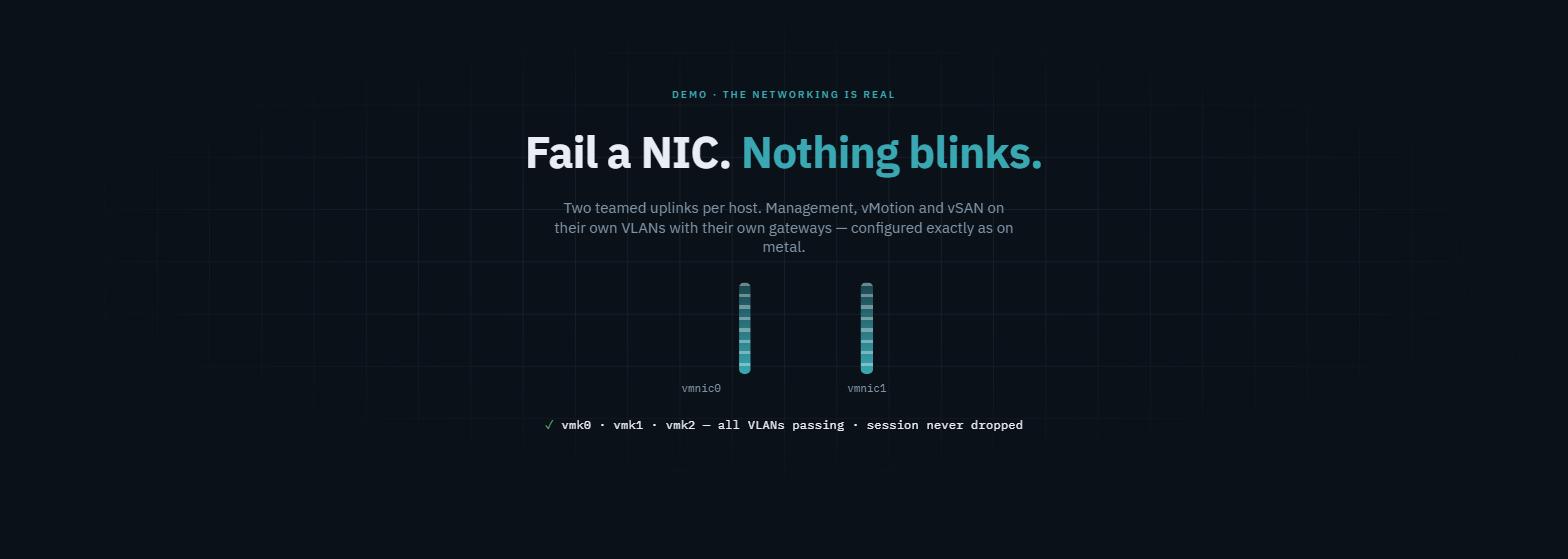
VCF wants two pNICs per host. In a nested lab the second vNIC adds no physical redundancy — so why add it? Because bringup validation and uplink teaming expect it, and because the failover test tells you something real about the trunk. vmnic0 down, 0% loss, and the SSH session watching it never dropped.

The nested-ESXi appliance sat at ‘waiting for DHCP’ forever. VPC subnets don’t hand out addresses — the VM Service does, through bootstrap providers. cloud-init for Linux, sysprep for Windows, OVF guestinfo for appliances, and the per-vmk gateway detail that makes the Host Client tell the truth.